ABOUT THE AUTHOR

Know more about Subhrashis.

JOURNEY OF SURVIVORS

Know about the unknown history of India. Click to Purchase.

5 QUESTIONS OF THE INQUISITIVE APES

Want to unveil the mystries of the universe? Want to know yourself? Want to be happy? Click to buy.

FOLLOW ON FB

Catch the latest posts.

FOLLOW ON INSTA

Keep up to date with the latest pictures.

WHATSAPP CONNECT

Talk to Author directly

Welcome to KHOJ: The search to know our roots and understand the meaning of our existence.

Prejudice is the biggest problem in the society. It can be it in terms of religion, cast, sex, skin-colour, status etc. Prejudice can also be in form of the feeling that human beings are the greatest creation, or even patriotism about artificially created borders. The motto of KHOJ is to gain knowledge and break that prejudice. But there is a word of caution for the readers. To break the prejudice KHOJ might throw upon you the concepts it believes in. If the reader believes on KHOJ’s perception without question, then KHOJ itself might incept a prejudice in the readers mind thus failing in it own motto. KHOJ is trying to break its own world of prejudice, but at times that prejudice might get reflected in its writing. Please do challenge them.
Showing posts with label World. Show all posts

Monday, April 20, 2020

How Stories Made Us...


“We are what we pretend to be, so we must be careful what we pretend to be.” - Kurt Vonnegut


Why did we paint the caves? What's the connection between the rock arts of hunters and gatherers, the ‘fiction’ of Harare and the ‘Maya’ of Upanisads? How are humans related to Zebra flinch? Why do we create stories and how did it make us the top predator? How can stories limit our potential? Can we script a new story to create a better world?


Thursday, April 16, 2020

LIFE GAMES to Fight COVID Grief


"These are extraordinary times, and we are probably living through a defining moment in human history."


"We are in grief, and the whole world is connected through that common thread of grief in an unprecedented way."

These are extraordinary times, and we are probably living through a defining moment in human history.This is not just a health crisis, but also a psychological one. We are scared about our health and that of our loved ones. We are worried about our finance and our future. We are in grief, and the whole world is connected through that common thread of grief in an unprecedented way. According to Kübler-Ross Model there are five stages of grief. If I adopt that model in the context of current situation, the five stages of COVID-grief can be summarized as below:
Denial: It is just another flu. We are immune.
Anger: It is a conspiracy. Blame the rich. Complete mismanagement.
Bargaining: Please save us, next time we will be better with the environment.
Depression: When will this end? The markets are down? My job is at risk.
Acceptance: It is what it is. This too shall pass.

It might not happen in that exact sequence, and sometimes negative thoughts can lead to vicious negative cycle that cause acute depression. Research show that depressed mood bias our memory towards negative emotion. This in turn increases the probability of recalling negative memory leading to further depression. To break the negative cycle we need to accept the situation we are in.  How do we move to the fifth stage of acceptance quickly? I am happy to share an approach that has worked for me, and I hope that it helps some of you. I have named it LIFE GAMES and it is a way of life that includes all our daily habits.


L for Low-carb Diet: Majority of us eats more carb than our body needs. Especially, refined carbs is known to lower the production of BDNF, a protein essential for creating strong neurological connections. Excessive sugar intake increases inflammation and can cause depression. Having said that, carbs are also important. Switch to healthy carbs like whole grains, legumes, vegetables and fruits, instead of white bread, white rice, pasta, sugary foods and potatoes. Do not add sugar to beverages. If required, Stevia might be a better alternative. The key is to have a balanced diet of both macro (Carbs, Proteins and fats) and micronutrients (vitamins and minerals). The requirements vary from person to person based on sex, health, age etc. Green leafy vegetables are rich in Vitamin B, whereas Vitamin C is found abundantly in citrus fruits. Green leafy vegetables, milk and dairy products and plant oils provide Vitamin A, D, E and K. Water is a source of essential minerals and 2-4 liters are recommended by WHO per day. Healthy body means to healthy mind.

I for Intermittent-fasting: It is amazing how cheap it is to stay fit. According to a study done in 2019 at the Okinawa Institute of Science and Technology, fasting increased levels of 44 different metabolites. These substances formed by our body’s metabolic processes help boost antioxidant levels in our body. Fasting kick-starts the process of autophagy which repairs our cells and our immune system, which is more important now than ever. I try to follow a 12-hour slot, dinner at 8 pm and breakfast at 8 am, and just have water, tea and coffee in between.

F for Flow: Flow is a mental state of intense focus, which we might also term as being ‘in the zone’. It is one of the most difficult mental state to achieve during lockdown. Working from home can be difficult, with added household chores that were once done by our helpers. Our brain is trained for separate home and office environment. Now both environments have collided leading to loss of focus. This can lead to stress. One of the key methods to get into the flow is to try and keep the two environment as separate as possible. The best way is to follow the routine of getting ready for work as in the pre-lockdown days, and find a separate space for your work where outside disturbance is minimum. Once office hours are over, return to you home environment and focus on your family.

E for Exercise: We are built to move and our traditional hunter-gatherer lifestyle kept us healthy. Our brains are hardwired to derive happiness, meaning, and a sense of belonging from physical activity. Recent studies show that regular exercise is good for our brains too. In fact it makes us more generous and cooperative. A brief 30 minutes of physical activity can lift our mood, reduce anxiety and make us positive. Exercise regime involves three types of movement: simple stretching, ones that involve strength and skill, and high-intensity interval training. Follow the one that suites.
"Reflecting on the positive aspects of ones life turns negative thoughts into positive ones."

G for Gratitude: Gratitude is one of the most powerful tools to get out of depression. Gratitude is a state of mind and can be irrespective of ones current situation. Reflecting on the positive aspects of ones life turns negative thoughts into positive ones. These are trying times for all of us, and is especially harsh to those in poverty. By contributing to the society in whatever means possible, and helping those in need can give us purpose and satisfaction. Maintaining a Gratitude Journal, by reflecting on the positive aspects of our life and write down five things we are thankful for, is known to help people get out of depression.

A for Aim: This is the right time to reflect at our life and find out our ultimate desires. Our desires are often guided by external world. It includes factors like fear of repercussions from others, guilt over hurting someone else, guilt over disappointing another and fear of being judged, criticized, or rejected. Find out things that matter to you and are not guided by the external world. It might be something tangible like traveling, or intangible like being more patient with your kid. This is true for professional life too. Write down the goals, break it down into smaller achievable entities, put a timeline, and periodically review your progress and develop goals for improvement. Having a vision for the future gives hope, reduces uncertainty and puts the chaos around us into perspective.

M for Mindfulness and Meditation: A 2011 research at Harvard revealed that students developed significantly denser concentrations of gray matter in their prefrontal cortex after an eight-week program in mindfulness training. Their brain changed in just few weeks leading to better focus, sensory processing, and planning abilities. Mindfulness also stimulates the parasympathetic nervous system (PNS), which makes us happy and relaxed. One of the easiest ways is to sit on your favorite chair where you are relaxed and comfortable. Try to focus on one thing: may be your breath, or the pressure exerted by the chair on your body, or your heart beat. Another way is to lie down, close your eyes and scan the body. It is important to be non-judgmental and open-hearted with yourself while doing this, and be compassionate toward your thoughts and feelings. The mind will wander, that is its nature. Be aware that it is wandering and then bring it back to focus. Simple practice of mindfulness for just 15min daily can have positive influence on our life.

E for Entertainment: Being stuck in you house for days, it is important to find ways to entertain oneself. Social media is one way to get entertained. The thing with Internet is that we often get stuck at its first letter ‘I’. To much focus on ‘I’ can lead to narcissism and depression. It is a good idea to fix a limited time for social media and limit exposure to negative news. Relationship is a key indicator of happiness. It is important to stay connected to friends and family through video calls and support each other. Hobbies like reading, drawing, writing, singing, dancing, etc is a very good way of staying away from the negativities. Playing games and watching movies together is also a great way of spending time together with you family.

S for Sleep: It is essential to have a good night’s sleep. It helps in maintaining the health of our brain. All of us have an internal clock called circadian rhythm. Breaking the rhythm leads to stress and leaves us feeling tired throughout the day. Lack of sleep releases hormone ghrelin, which increases hunger and lowers levels of leptin, which regulates metabolism. Improper metabolism can make us tired and even depressed. It is recommended to have at least 7 hours of sleep every day.

"Human species are as complicated as they are resilient."

Human species are as complicated as they are resilient. While there is no one-size-fits-all approach to help us, I am sure we will all find our own way through this pandemic. The strength of our species is that we adapt, no matter what the situation is. The post COVID world could be entirely different from the world we are used to. But that might not necessarily be a bad thing. Together we will definitely craft a better future for all.

Subhrashis Adhikari
Author: 5 Questions of the Inquisitive Apes
www.subhrashis.com


"Engaging and entertaining, this page-turner is remarkable in its narration and will give you a new perspective on various aspects of life. Wellresearched and heartfelt, the encouraging tone throughout the book tries to motivate towards a happier life." - Times of India

Link:


Monday, March 23, 2020

THE PRICE OF NOT STAYING AT HOME

REF: WIKI


The world is never going to be the same again. It is upto us whether the change is for better or for worse.
One infected patient can transmit COVID-19 to ~3 new people (average transmission rate). The virus spreads exponentially. And we might not even not know that we are spreading it. COVID-19 spread even before you have symptoms from it. India is currently in stage-2. It won’t take long before it reaches stage-3. The result would be disastrous and would hunt us for ages. Why?


Population of India: 138,00,04,385 people
If only 0.001% is affected we have: 13,80,005 patients
That is 1,90,440 people with severe cases (13.8%)
And over 55,000 critical cases (4%).

India has around 10 hospital beds per 10,000 people while the global average is 30 beds per 10,000 people (Italy 34). We have around 70,000 ICUs(2008) and ~4000 ventilators. Once they get filled... all critical patients, flu or not, will die.
 Over 50,000 people can end up being dead if just 0.001% of population is affectedThis virus has the potential to affect 60% of world population within a year.
 The graph below is not the real number. It is the number based on people tested. The real number would be worse.


Can we let it die its natural death? Yes, but at a high price. We would end up infecting billions and killing millions. And that is not a one time process. Viruses mutate, and COVID-19 is already mutating. Which means that surviving this one does not guarantee survival from its next generation, and then the next. Herd immunity is not the solution.


So what can we do?

Not often do we get the opportunity to save the world by staying at home. It is a rare opportunity that we should not miss. 

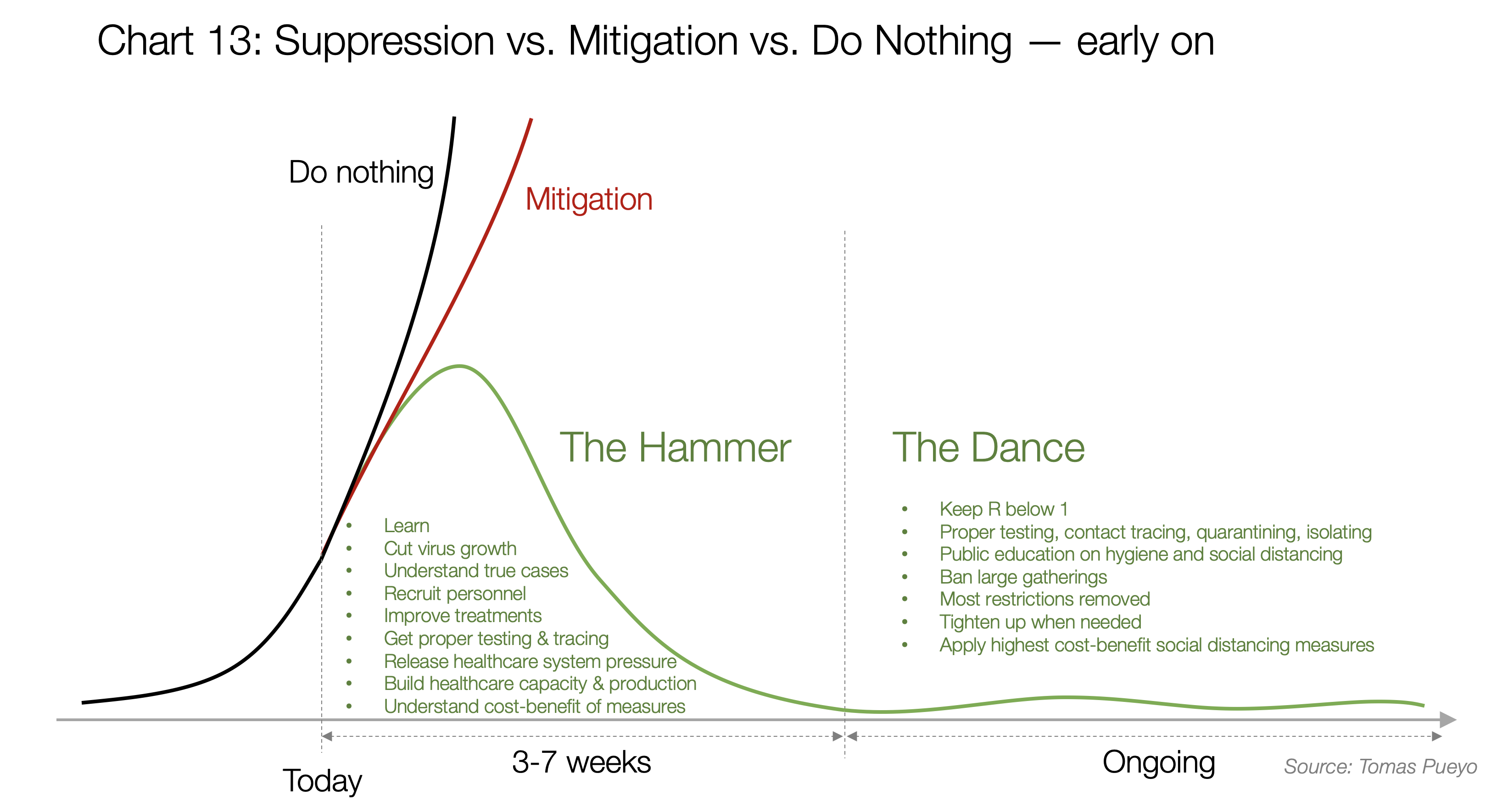
Complete lock down, not the soft ones like Italy, but a stringent one can cut the transmission rate to almost nil. That would give us time, and time is gold. Why?


Sure we cannot lock ourselves for months and let the economy die. Good news is, if we act now, it won’t take months. With government help, within weeks 

  • We can develop faster testing method, conduct massive testing and quarantine potential candidates. 
  • We can train people to identify symptoms early and isolate them. 
  • We can educate people on personal distance, mask wearing, hand washing and disinfecting spaces. 
  • We can also build more facilities for treatment. 


By flattening the curve we can make sure that the hospitals are not running out of their capacity. 
It will give us time to know our enemy and eliminate it with minimum casualty.
Social distancing is not just a theory, it works. Check the simulation by Saptarshi Das
a close up of text on a white background
REF: https://www.linkedin.com/posts/saptarshiprofile_socialdistancing-modeling-simulations-activity-6647500610230988800-2px6


REF# https://medium.com/@tomaspueyo/coronavirus-the-hammer-and-the-dance-be9337092b56

As we slowly release the restrictions after a month, we walk out into a new world. More hygienic, less mass gatherings, stricter travel regulations…but life will go on and slowly even the economy will recover. And maybe by then we would have a medical breakthrough. 

Hopefully this new world would be a better world where we realise the value of life and nature. Hopefully we will slow down and take a break from the rat race. As we accelerate the Global Warming and melt the polar ice, as we keep spreading into remote corners of the globe, we never know which new and deadly creature is lurking in the dark. 
 COVID-19 just a mild warning. We better learn.

For the moment, stay at home… save thousands of life!


REF:
https://www.technologyreview.com/s/615375/what-is-herd-immunity-and-can-it-stop-the-coronavirus/
https://medium.com/@tomaspueyo/coronavirus-act-today-or-people-will-die-f4d3d9cd99ca
https://medium.com/@tomaspueyo/coronavirus-the-hammer-and-the-dance-be9337092b56
https://theprint.in/opinion/current-rate-india-30000-covid-19-deaths-may-no-hospital-bed-june-data/385386/?fbclid=IwAR1xO3W9EgL3GcYyxw2Niq4N5Sih3yhFEnYgWgFy1hOB9-PVVbL_bqpSzQc
https://www.hindustantimes.com/india-news/govt-preps-for-spike-in-covid-19-cases-okays-plan-to-make-more-ventilators/story-uOd5YFyqSGun0FeUf0JzCO.html
https://www.ncbi.nlm.nih.gov/pmc/articles/PMC2738307/
https://data.worldbank.org/indicator/SH.MED.BEDS.ZS


Written by Subhrashis Adhikari

"Engaging and entertaining, this page-turner is remarkable in its narration and will give you a new perspective on various aspects of life. Wellresearched and heartfelt, the encouraging tone throughout the book tries to motivate towards a happier life." - Times of India

Link:


Sunday, December 15, 2019

Compassion - The Future World


In a future world of greater population, limited resource, global warming, and technology threatening our jobs, the risks are global. They would need global solutions. Is there solution to our global problems?

Human brain is a complex mass of tufu-like protein that guides us through our life. Information travels faster than any F1 car inside our brains. It acquires, processes, interprets and stores information, while creating prejudices and biases. Every thought and memory that the brain generates is a complex process that uses several parts of the brain. Science is yet to unravel it’s mystery. What we do know is that it has evolved over millions of years from a rather humble beginning. 

The reptilian brain was the first to evolve. It controls the vital functions that help us survive, including heart rate, breathing, body temperature and balance. The basic instincts like hunger, thirst, survival and desire to procreate is rooted in this primitive brain. In other words, it controls our desires. The main structures of reptilian brain are brain stem and cerebrum. Reptilian brain represents our nature. In nature the fittest survive. Indians call it ‘prakriti’, which is guided by the rule of the jungle ‘matysa nyaya’. According to the rule, big fish eats small fish.

The next part of the brain that evolved is the palaeo-mammalian brain. Its main structures are hippocampus, amygdala, and the hypothalamus. This part of the brain gives us emotions and binds us together. Morality and empathy comes dominantly from the mammalian brain. It makes sure that even the weak survive, as long as (s)he belongs to the same group. Rule of ‘prakriti’ changes to rule of ‘sanskriti’. Sanskriti is culture, or a set of social rules that defines a group. The group can be a tribe, a religion or a nation. Matysa Nyaya is now modified to big (read powerful) groups eating (exploiting) small (weak) groups. According to the new rule, a small fish in a big group has more chance of survival than a big fish in a small group. Empathy is the glue that helps the group bond strongly. 

The connection of empathy is created through mirroring as discussed in the last post. We are less empathetic towards people we consider as ‘others’ who does not mirror our ideas and expressions. If empathy is the factor that helps creates groups, and you are empathetic towards people you can relate to, then empathy is limited by the Dunbar number. It is the suggested cognitive limit to the number of people whom you can consider as close and relate to. For most humans it is close to 150 individuals. Stories like religion or nationalism can loosely bind a bigger group, but it is not the strong glue of empathy.

Neo-mammalian brain (or primate brain), i.e. the neocortex, is the latest to evolve. Our cognitive abilities and intelligence is derived from this part of the brain. The Prefrontal Cortex (PFC) of neo-mammalian brain is involved in all executive functions, ability to plan, decision making, expressing our personality, aligning our thoughts and actions with internal goals, and moderating social behaviour. Basal Ganglia, also part of neo-mammalian brain, store routine, repetitive behaviours, and thoughts. Habits are stored in form of thousands mini-programs or maps which helps brain go on autopilot and save energy. 

Neo-mammalian brain gives us the ability to change ourselves. I must mention here that the three parts of the grain is a simplification, but a good analog. We have done enough research to understand the limitations of our brain and know our cognitive biases. While bigotory, racism, sexism etc still exists, we are slowly getting over it. The laws around the globe are more liberal than they were a century ago. According to Steven Pinker, the world is more peaceful that it ever was. But, how can we get better?

We can create a better world if we find a way to be compassionate about everyone else irrespective of the group they belong to. If we use our PFC to set a goal of being compassionate, and practice it consciously everyday then it becomes a mini-program that gets stored in our Basal Ganglia. One can become compassionate by practicing.

All cognitive information gets stored as memories called engrams.The way we act and think results in biophysical or biochemical changes in the brain and other neural tissues. By visualising a particular outcome or goal that you seek changes your brain. It makes you more positive and increases the likelihood of the outcome. Positive faith leads to positive results through placebo effect.

According to Indian philosophy actions leave behind mental impressions in our minds, called samskara. Samskara affects our future actions and thoughts. That is Karma. Compassion and kindness is contagious and can be rewarding. When you give compassion, it comes back to you.

If we want a better future, we need to erase the borders and create a compassionate world. Compassion not just for fellow beings, but also towards other species. It might sound too idealistic at the moment. A democratic world was once idealistic too. We have changed, and we will keep changing. 

The future world would be very different from what it is today. Next time when you think of someone, try consciously to forget about the identity of the other person. That person may belong to a group that had exploited your group in the past, that person might be from another country that you now consider your enemy. Forget all that identity and think about compassion. That person might still live in the medieval era of bigotry. That is not a good enough reason for you to turn into a bigot too. 

As the old cliche goes, be the change you want to see in the world. We have moved from prakriti to sanskriti. Now it is time to move towards global citizenship - vasudhaiva kutumbakam.


REF


Written by Subhrashis Adhikari


"Engaging and entertaining, this page-turner is remarkable in its narration and will give you a new perspective on various aspects of life. Wellresearched and heartfelt, the encouraging tone throughout the book tries to motivate towards a happier life." - Times of India

Link:


Thursday, October 31, 2019

Legend of Alexander

Alexander the Great Mozaic (Wiki)

After a day of acclimatization for the oxygen starved high altitudes of Ladakh we started our long drive towards Dah to meet Alexander’s kin. It was a hot sunny day and we had to stop 5 kilometres short of Dah. The heat from the scorching sun has melted too much snow, raising the height of water in the river to dangerous levels. Indus, the mighty river that Alexander once crossed to enter India, has overflowed and blocked our path to Dah. But it happened to be our lucky day. 

We came to know from the locals that there is another region where the so-called ‘Pure Aryans’ live. We took a difficult curvy road, up the mountain, to reach the Sanith village that consisted of only 24 houses. The people here look and speak a language different from the Ladakis. These Western Ladakhi people belong to Brokpas or Minaro tribe and speak archaic Shina language. They can be easily identified by their flowery headdress. They prefer to call themselves ‘pure Aryan’ whose ancestors were part of Alexander’s lost army. 

My driver insisted that they speak Aryan language that is a mixture of Hindi and English. Interestingly, though he understands both English and Hindi, he cannot decipher their language. Genetic studies done on the people of Brokpas or Minaro tribe show only a faint Greek connection. As we saw earlier, ‘Aryan’ is not a race, rather a linguistic division. Whatever their origin is, our romanticism with fair skin helps this little isolated tribe with tourism. Being ‘pure Aryans’ did not bring tourism; rather it was tourism that made them ‘pure Aryans’.

Brokpas

Alexander III of Macedon was one of the greatest kings of the ancient world. His father, King Philip, was a great soldier who carved out a powerful army. His mother, Olympias, was a fierce tribal princess who kept snakes as pets. According to rumours, Olympias was struck by a bolt of lightening and was visited by the king of gods, Zeus, when she was pregnant. Hours later Alexander was born. Born under the sign of Leo, the king of beasts, Alexander was destined to achieve greatness. In a single decade he forged an empire as large as the ones Roman Empire accumulated over centuries.

Alexander in Persia

While many tribes have entered India over the ages, Alexander is considered as the first king to have crossed the Indus. There are lots of myths surrounding the legend of Macedon. Thousands of years ago, when the gods walked with the mortals, Indian saints unravelled the mystery of immortality. The magic was found in the juice of Soma plants, growing in the banks of the great Indus River. Alexander the Great, known locally as Sikander, came to know about it and wanted to find it so that he could rule the world eternally. In his voyage, he befriended a local person who was guiding him towards the secret and sacred place. After a point of time they parted ways to make the search quicker. One day, accidentally, a dried fish fell into a spring from the hand of Sikander’s friend. To his surprise, the dead fish came back to life and swam away. Sikander’s friend realized that he had found the fountain of life, also known as Aab-i-Hayat. He drank from the magical spring and told the soldiers to inform Sikander. By the time Sikander reached, the magical spring vanished along with his friend. Sikander’s dream remained unfulfilled, but his friend became a legend. His story can be traced back to the Gilgamesh epic, the Alexander romances, the Jewish legend of Elijah and Rabbi Joshua ben Levi, and even the Koran. He is known by many names. He is al-Khadir or Khwaja Khizr of Muslims, and Uderolal or Jind Pir of Hindus. He is the immortal prophet whose abode is a green island in the Indus River.  With a long white beard he rides along the banks of the river on a pala fish, helping people in trouble.
Khwaja Khizr

In 326BC Sikander became the first western king to cross the Indus River. He allied with the king of Taxila (also called Takshashila), Ambhi Kumar. That alliance was one of the reasons why Taxila University survived Sikander’s onslaught. Sikander’s men saw the university, the ‘like of which was not seen in Greece’. With help from Ambhi, Sikander built a bridge across Indus River. However, his confidence was shattered the moment he crossed into India. Sikander did manage to win against the resilient smaller Indian border tribes called Asvakas but only after a tough fight. The Asvaka women took up arms and fought alongside their men. They preferred a glorious death to a life of dishonor. Sikander was wounded in the fighting. The Macedonian army slaughtered the entire population of Massaga and Ora. However, Sikander’s soldiers were tired after the long and eventful journey away from home. They were now facing the most powerful empire they had encountered so far. With a small army, he easily defeated the mighty Persian Empire. However, he faced his toughest opponent in the form of Puru (Greek Porus), a ruler of a small Indian kingdom. The huge Indian war elephants and their superior weapons, like the two-metre bow, made the army of Puru formidable despite their small numbers. Sikander’s strength was his tactics and battle plan. He had no shortage of supply in the fertile Indus plain and maintained a continuous shipment of equipments all the way from Macedonia.


Alexander’s bold and unexpected move to cross the river at peak monsoon tilted the balance of the war in his favor. The Macedoian king marched across the river at night with 5,000 cavalry and 10,000 infantry, leaving behind major chunk of his soldiers and one person dressed as the king to deceive Puru. By the time Puru came to know about this unexpected move it was late. He assumed it to be a ruse, and send his son with just 2000 cavalry and 120 chariots to counter the attack. That was the blunder that cost Puru the war. Puru’s son died in the battle but not before wounding Sikander and killing his enemy’s favourite horse. It was still a moral victory for Sikander’s men. On hearing the news of his son’s death, fuming Puru attacked Sikander with his main force. After a long and fierce fighting Sikander managed to win the Battle of Hydaspes, but not before it left his army devastated. It was the costliest battle fought by Sikander’s men. Sikander was impressed by the bravery of Puru and asked him how he should be treated. Puru replied, ‘Like a king’. Alexander asked again if he had anything else to request. Puru explained, ‘Everything is comprised in the words, like a king’.


Puru accepts defeat

On the east of Ganges, India’s most powerful kingdoms were ready to take on Sikander. Sikander retreated, fearing a valiant attack from the joint forces of Nanda dynasty of Bihar and Gangaridai Empire of Vanga (which could well be the same empire). According to the writings of Greek authors like Megasthenes and Ptolemy, Gangaridai was the most powerful empire in India at that time. They maintained an army of ‘20,000 horses, 200,000 infantry, 2,000 chariots and 4,000 elephants trained and equipped for war’. Ruins of the empire have been excavated from a small village called Berachampa, just ~35 kilometres from Kolkata. It was probably the biggest army in the world of that time. Sikander’s army was homesick and was in no mood to take on their biggest foe. Fearing mutiny in his own camp, Sikander had to turn back disappointed without fulfilling his dream of conquering the world. The return journey happened through water instead of land. The ships sailed in the late 326BCE from Jhelum and Indus to the Arabian Sea. The downriver journey took six months due to the constant attack from the riverine people who have heard horrible tales about the conqueror of the world. One of the arrows stuck Sikander in the chest. He succumbed to the wounds around three years later.

Alexander the Great Receiving News of the Death by Immolation of the Indian Gymnosophist Calanus - Jean-Baptiste de Champaigne - 1672, Ref - Wiki

Once, while in India, Sikander asked a group of Jain philosophers why they were ignoring the great conqueror. The philosophers replied, ‘King Alexander, every man can possess only so much of earth’s surface as this we are standing on. You are but a human like rest of us. . . . You will soon be dead, and then you will own just as much of the earth as will suffice to bury you.’ Jainism was a dominant religion in Western India at that time and the wise monks impressed Sikander. He was especially fond of Calanus of Taxila, who criticized Greek philosophy with his sharp logic. The king took him to Persia as a teacher. At an age of 73 years Calanus decided that we was too weak to live anymore. The harsh weather of Persia took a toll on his body. The naked philosopher self-immolated himself, despite dissuasion from his legendary disciple. His last word to the king was, ‘We shall meet in Babylon’. But Sikander has no plans of going to Babylon. As fate would have it, that is where one of the greatest king of the world breathed his last. For the Indians, Sikander’s adventures were just a minor skirmish at the borders. Sikander did not leave behind much impact on Indian culture and thus hardly finds any mention in the contemporaneous texts. However, he did leave behind a porous connection between east and west through which art, science and culture diffused slowly over time. It is through the same border that a series of invasions took place.


Reference

Also Check Out:  5 Questions of the Inquisitive Apes 

Written by Subhrashis Adhikari
"Engaging and entertaining, this page-turner is remarkable in its narration and will give you a new perspective on various aspects of life. Wellresearched and heartfelt, the encouraging tone throughout the book tries to motivate towards a happier life." - Times of India

Link:


Monday, October 21, 2019

Is there Free Will?


In this age of information, we are constantly being bombarded with data that affect our perception. Often times, the media persistently project a single story that gets imprinted in our brains, leading to prejudice. A country like India can be thought of as very unsafe for women. US could be thought of as a precarious place where you might get shot down the moment you land. People from Nigeria might be considered as tribal, even though Nigeria has perfectly modern cities. Once we are anchored to a particular way of thinking, it becomes very difficult to get rid of the prejudices. We often fail to comprehend that our opinion might be just one of the thousand possible stories that we have never heard. The single stories themselves may not be wrong. But, it is just a one-sided story. Truth is multi-faceted. Is our future multi-faceted too? Or is it that we do not have any free will?


"The problem of free will is not about the lack of choice or determinism, but about the way we choose."

Scott Adam’s 2004 Dilbert cartoon aptly says, ‘Free will is an illusion. People always choose the perceived path of greatest pleasure.’ Do we have free will? One would have thought that science has already solved this problem. Quite surprisingly, it hasn’t. It has only changed the way we look at the question. No more do we think that we are at the mercy of some higher powers. The problem of free will is not about the lack of choice or determinism, but about the way we choose. We may like to think that we are in control of our life, at least till we get married! Unfortunately, most of the things that happen to us are outside our control. I did not choose when, where and to whom I was born. I did not select my genes. And in all likelihood, I will have no free will about my death. My looks, my gender, my religion and nationality were predetermined. However, all these factors had a strong influence in determining who I am today. My genetics determines my nature, and my family determines my nurture. This means that we can never have complete freedom of choice. Random events along with our nature and nurture limit the choices we have. Having said that, there are a lot of things that are within our sphere of influence, like the way I want to colour my hair, the profession I want to be in, choosing my partner or when to have a baby. Even the choices that are in our control are influenced by external factors, especially our family. Rich people will have a different set of options than poor people for the same problem. Often our parents and teachers influence our career and thus the profession we choose. Choosing your partner is not just a one-sided decision; the other person needs to agree as well. When to have a baby, and sometimes even what colour you want your hair to be, is often a decision that you make along with your partner. How much of free will does that leave us with?


"We are a very negligible part of the entire universe. If the laws of physics guide everything in the universe, including the birth of the galaxy and origin of life, then why would our thoughts, or we for that matter, be any different?"

Let us ignore all the external factors for the time being and say that only you decide what to choose. When I started having thyroid problems, I noticed that I lost my temper very easily. I became a different person. It made me realize that a lot of what we are depends on the biochemical that flow in our body. These, in turn, depend on our brain. This is well documented in the case of Phineas P. Gage. In 1848, Gage suffered a major accident and lost a part of his brain. The loss of that particular part of the brain, prefrontal lobe to be exact, turned a cheerful well- mannered gentleman into a self-destructive habitual liar. Similar cases have been observed with other individuals with damaged prefrontal lobe. The prefrontal lobe, we now know, controls our emotions. Recent studies in neuroscience indicate that our thoughts could well be a product of biochemical algorithms written in our brain.


"We often fail to comprehend that our opinion might be just one of the thousand possible stories that we have never heard."

How we behave and react to situations depend more on the structure of our brain rather than the situation itself. Take for example the feelings of fear, anger, lust and love. They are the same all around the globe because they stem from the genetic make-up of our species and those feelings results from secretion of same biochemicals. When we are threatened, our brain releases adrenalin and cortisol that create the feeling of fear. Lust is governed by dopamine while the feeling of love by oxytocin. These chemicals are not any different for an African or a Chinese or a European. These chemicals can even be released artificially by intake of drugs or stimulating the right part of the brain through electrodes. We will have the feeling, corresponding to the part that is triggered, without any reason for feeling the same. What if the choice you are about to make is guided by your brain’s chemistry, determined by your genes and memories that you have no control over, following all the rules of physics that are fixed? We are a very negligible part of the entire universe. If the laws of physics guide everything in the universe, including the birth of the galaxy and origin of life, then why would our thoughts, or we for that matter, be any different?


This begs the question, where is free will? An interesting experiment was done almost 35 years ago by Dr. Benjamin Libet. Libet’s Experiment demonstrated that the unconscious response precedes, and potentially cause conscious or volitional decisions 300 milliseconds before you actually take that decision! If our unconscious mind is deciding for us, then it puts some serious doubts on our free will. Are we mistaking randomness for free will? The experiment received widespread fame and critics. May be our conscious mind has a veto power. May be, the way the experiment was conducted had flaws. Even then, we cannot disagree about the fact that absolute free will is a myth.


A 40-year-old man became addicted to child pornography after he developed tumour in the or bitofrontal cortex. Once the tumour was removed, his addiction vanished. Similarly, Charles Whitman, a 25-year-old loving husband suddenly turned into a mass murderer. The cause was a large tumour that pressed down his amygdala, a part of the brain that controls emotion. This brings us to the dilemma of justice. Who do we blame in such situation, the person or the tumour? Every decision we take is in some way affected by our genes, the way we were brought up, and any changes or damages that may happen to our brain. Some might argue that it is the non-conscious process in the brain that drives all our actions. While we can never be completely free, I would like to believe that we are not completely helpless about deciding our future. Or, at least my brain would want me to believe that. While the biochemical inside our body affect our behaviour, our behaviour in turn can affect the chemicals. With help of the right lifestyle, we can change the way we behave. With the help of medical treatments we can cure thyroid problems or tumours. I sincerely hope that it is not the apparent chaos which gives us the illusion of free will.


"We can go to the extent of saying that our perception is more of a hallucination than reality."

The way we make sense of the world depends on the way our brain receives information coming through the sense organs and make stories. In truth, we cannot sense anything directly. All our perceptions are indirect, with the help of proxies. We can go to the extent of saying that our perception is more of a hallucination than reality. One might say that our sense organs do a pretty good job of replicating the reality in our minds. That is why my interpretation of the world broadly matches yours. The Taj Mahal is the same for all the people who have seen it. Its beauty might be just in our brain, but the physical reality of the Taj Mahal has to exist. There must be a fundamental reality that is beyond the boundaries of our mind. What if we all are biased in the same way? We have evolved together and almost have the same genes. Since our brain is similar, our understanding has to be similar. 

Then there are a lot of things that we assume should match, actually does not. Different people interpret the same thing in different ways. Some may observe details, while others see the big picture. Some people have brains focused on facts, while others may be more imaginative. There is no right or wrong way to make sense of the universe. 

Even fundamental things like time and space are more mysterious than we think. Experiments in quantum physics are destroying the very fabric of our known comfortable world. And, it is not just at the micro scale. New experiments are replicating the weirdness of quantum world in macro scale. All possible realities might exist, and we just happen to remember one at a time. May be in one of the universes it is Schrödinger who is in the box and is both dead and alive till Dr. Cat opens it. The single universe of Classical Physics might be the simplified story that our brain writes. Does the Heisenberg uncertainty give us free will? It is more of a hope. The arrow of time works both ways in physics. If all possibilities exists and at all times....then each and every possibility is already fixed.


"All possible realities might exist, and we just happen to remember one at a time."


From the Book  5 Questions of the Inquisitive Apes

Written by Subhrashis Adhikari
"Engaging and entertaining, this page-turner is remarkable in its narration and will give you a new perspective on various aspects of life. Wellresearched and heartfelt, the encouraging tone throughout the book tries to motivate towards a happier life." - Times of India
Link: