ABOUT THE AUTHOR

Know more about Subhrashis.

JOURNEY OF SURVIVORS

Know about the unknown history of India. Click to Purchase.

5 QUESTIONS OF THE INQUISITIVE APES

Want to unveil the mystries of the universe? Want to know yourself? Want to be happy? Click to buy.

FOLLOW ON FB

Catch the latest posts.

FOLLOW ON INSTA

Keep up to date with the latest pictures.

WHATSAPP CONNECT

Talk to Author directly

Welcome to KHOJ: The search to know our roots and understand the meaning of our existence.

Prejudice is the biggest problem in the society. It can be it in terms of religion, cast, sex, skin-colour, status etc. Prejudice can also be in form of the feeling that human beings are the greatest creation, or even patriotism about artificially created borders. The motto of KHOJ is to gain knowledge and break that prejudice. But there is a word of caution for the readers. To break the prejudice KHOJ might throw upon you the concepts it believes in. If the reader believes on KHOJ’s perception without question, then KHOJ itself might incept a prejudice in the readers mind thus failing in it own motto. KHOJ is trying to break its own world of prejudice, but at times that prejudice might get reflected in its writing. Please do challenge them.
Showing posts with label current affairs. Show all posts

Thursday, April 16, 2020

LIFE GAMES to Fight COVID Grief


"These are extraordinary times, and we are probably living through a defining moment in human history."


"We are in grief, and the whole world is connected through that common thread of grief in an unprecedented way."

These are extraordinary times, and we are probably living through a defining moment in human history.This is not just a health crisis, but also a psychological one. We are scared about our health and that of our loved ones. We are worried about our finance and our future. We are in grief, and the whole world is connected through that common thread of grief in an unprecedented way. According to Kübler-Ross Model there are five stages of grief. If I adopt that model in the context of current situation, the five stages of COVID-grief can be summarized as below:
Denial: It is just another flu. We are immune.
Anger: It is a conspiracy. Blame the rich. Complete mismanagement.
Bargaining: Please save us, next time we will be better with the environment.
Depression: When will this end? The markets are down? My job is at risk.
Acceptance: It is what it is. This too shall pass.

It might not happen in that exact sequence, and sometimes negative thoughts can lead to vicious negative cycle that cause acute depression. Research show that depressed mood bias our memory towards negative emotion. This in turn increases the probability of recalling negative memory leading to further depression. To break the negative cycle we need to accept the situation we are in.  How do we move to the fifth stage of acceptance quickly? I am happy to share an approach that has worked for me, and I hope that it helps some of you. I have named it LIFE GAMES and it is a way of life that includes all our daily habits.


L for Low-carb Diet: Majority of us eats more carb than our body needs. Especially, refined carbs is known to lower the production of BDNF, a protein essential for creating strong neurological connections. Excessive sugar intake increases inflammation and can cause depression. Having said that, carbs are also important. Switch to healthy carbs like whole grains, legumes, vegetables and fruits, instead of white bread, white rice, pasta, sugary foods and potatoes. Do not add sugar to beverages. If required, Stevia might be a better alternative. The key is to have a balanced diet of both macro (Carbs, Proteins and fats) and micronutrients (vitamins and minerals). The requirements vary from person to person based on sex, health, age etc. Green leafy vegetables are rich in Vitamin B, whereas Vitamin C is found abundantly in citrus fruits. Green leafy vegetables, milk and dairy products and plant oils provide Vitamin A, D, E and K. Water is a source of essential minerals and 2-4 liters are recommended by WHO per day. Healthy body means to healthy mind.

I for Intermittent-fasting: It is amazing how cheap it is to stay fit. According to a study done in 2019 at the Okinawa Institute of Science and Technology, fasting increased levels of 44 different metabolites. These substances formed by our body’s metabolic processes help boost antioxidant levels in our body. Fasting kick-starts the process of autophagy which repairs our cells and our immune system, which is more important now than ever. I try to follow a 12-hour slot, dinner at 8 pm and breakfast at 8 am, and just have water, tea and coffee in between.

F for Flow: Flow is a mental state of intense focus, which we might also term as being ‘in the zone’. It is one of the most difficult mental state to achieve during lockdown. Working from home can be difficult, with added household chores that were once done by our helpers. Our brain is trained for separate home and office environment. Now both environments have collided leading to loss of focus. This can lead to stress. One of the key methods to get into the flow is to try and keep the two environment as separate as possible. The best way is to follow the routine of getting ready for work as in the pre-lockdown days, and find a separate space for your work where outside disturbance is minimum. Once office hours are over, return to you home environment and focus on your family.

E for Exercise: We are built to move and our traditional hunter-gatherer lifestyle kept us healthy. Our brains are hardwired to derive happiness, meaning, and a sense of belonging from physical activity. Recent studies show that regular exercise is good for our brains too. In fact it makes us more generous and cooperative. A brief 30 minutes of physical activity can lift our mood, reduce anxiety and make us positive. Exercise regime involves three types of movement: simple stretching, ones that involve strength and skill, and high-intensity interval training. Follow the one that suites.
"Reflecting on the positive aspects of ones life turns negative thoughts into positive ones."

G for Gratitude: Gratitude is one of the most powerful tools to get out of depression. Gratitude is a state of mind and can be irrespective of ones current situation. Reflecting on the positive aspects of ones life turns negative thoughts into positive ones. These are trying times for all of us, and is especially harsh to those in poverty. By contributing to the society in whatever means possible, and helping those in need can give us purpose and satisfaction. Maintaining a Gratitude Journal, by reflecting on the positive aspects of our life and write down five things we are thankful for, is known to help people get out of depression.

A for Aim: This is the right time to reflect at our life and find out our ultimate desires. Our desires are often guided by external world. It includes factors like fear of repercussions from others, guilt over hurting someone else, guilt over disappointing another and fear of being judged, criticized, or rejected. Find out things that matter to you and are not guided by the external world. It might be something tangible like traveling, or intangible like being more patient with your kid. This is true for professional life too. Write down the goals, break it down into smaller achievable entities, put a timeline, and periodically review your progress and develop goals for improvement. Having a vision for the future gives hope, reduces uncertainty and puts the chaos around us into perspective.

M for Mindfulness and Meditation: A 2011 research at Harvard revealed that students developed significantly denser concentrations of gray matter in their prefrontal cortex after an eight-week program in mindfulness training. Their brain changed in just few weeks leading to better focus, sensory processing, and planning abilities. Mindfulness also stimulates the parasympathetic nervous system (PNS), which makes us happy and relaxed. One of the easiest ways is to sit on your favorite chair where you are relaxed and comfortable. Try to focus on one thing: may be your breath, or the pressure exerted by the chair on your body, or your heart beat. Another way is to lie down, close your eyes and scan the body. It is important to be non-judgmental and open-hearted with yourself while doing this, and be compassionate toward your thoughts and feelings. The mind will wander, that is its nature. Be aware that it is wandering and then bring it back to focus. Simple practice of mindfulness for just 15min daily can have positive influence on our life.

E for Entertainment: Being stuck in you house for days, it is important to find ways to entertain oneself. Social media is one way to get entertained. The thing with Internet is that we often get stuck at its first letter ‘I’. To much focus on ‘I’ can lead to narcissism and depression. It is a good idea to fix a limited time for social media and limit exposure to negative news. Relationship is a key indicator of happiness. It is important to stay connected to friends and family through video calls and support each other. Hobbies like reading, drawing, writing, singing, dancing, etc is a very good way of staying away from the negativities. Playing games and watching movies together is also a great way of spending time together with you family.

S for Sleep: It is essential to have a good night’s sleep. It helps in maintaining the health of our brain. All of us have an internal clock called circadian rhythm. Breaking the rhythm leads to stress and leaves us feeling tired throughout the day. Lack of sleep releases hormone ghrelin, which increases hunger and lowers levels of leptin, which regulates metabolism. Improper metabolism can make us tired and even depressed. It is recommended to have at least 7 hours of sleep every day.

"Human species are as complicated as they are resilient."

Human species are as complicated as they are resilient. While there is no one-size-fits-all approach to help us, I am sure we will all find our own way through this pandemic. The strength of our species is that we adapt, no matter what the situation is. The post COVID world could be entirely different from the world we are used to. But that might not necessarily be a bad thing. Together we will definitely craft a better future for all.

Subhrashis Adhikari
Author: 5 Questions of the Inquisitive Apes
www.subhrashis.com


"Engaging and entertaining, this page-turner is remarkable in its narration and will give you a new perspective on various aspects of life. Wellresearched and heartfelt, the encouraging tone throughout the book tries to motivate towards a happier life." - Times of India

Link:


Monday, March 23, 2020

THE PRICE OF NOT STAYING AT HOME

REF: WIKI


The world is never going to be the same again. It is upto us whether the change is for better or for worse.
One infected patient can transmit COVID-19 to ~3 new people (average transmission rate). The virus spreads exponentially. And we might not even not know that we are spreading it. COVID-19 spread even before you have symptoms from it. India is currently in stage-2. It won’t take long before it reaches stage-3. The result would be disastrous and would hunt us for ages. Why?


Population of India: 138,00,04,385 people
If only 0.001% is affected we have: 13,80,005 patients
That is 1,90,440 people with severe cases (13.8%)
And over 55,000 critical cases (4%).

India has around 10 hospital beds per 10,000 people while the global average is 30 beds per 10,000 people (Italy 34). We have around 70,000 ICUs(2008) and ~4000 ventilators. Once they get filled... all critical patients, flu or not, will die.
 Over 50,000 people can end up being dead if just 0.001% of population is affected. This virus has the potential to affect 60% of world population within a year.
 The graph below is not the real number. It is the number based on people tested. The real number would be worse.


Can we let it die its natural death? Yes, but at a high price. We would end up infecting billions and killing millions. And that is not a one time process. Viruses mutate, and COVID-19 is already mutating. Which means that surviving this one does not guarantee survival from its next generation, and then the next. Herd immunity is not the solution.


So what can we do?

Not often do we get the opportunity to save the world by staying at home. It is a rare opportunity that we should not miss. 

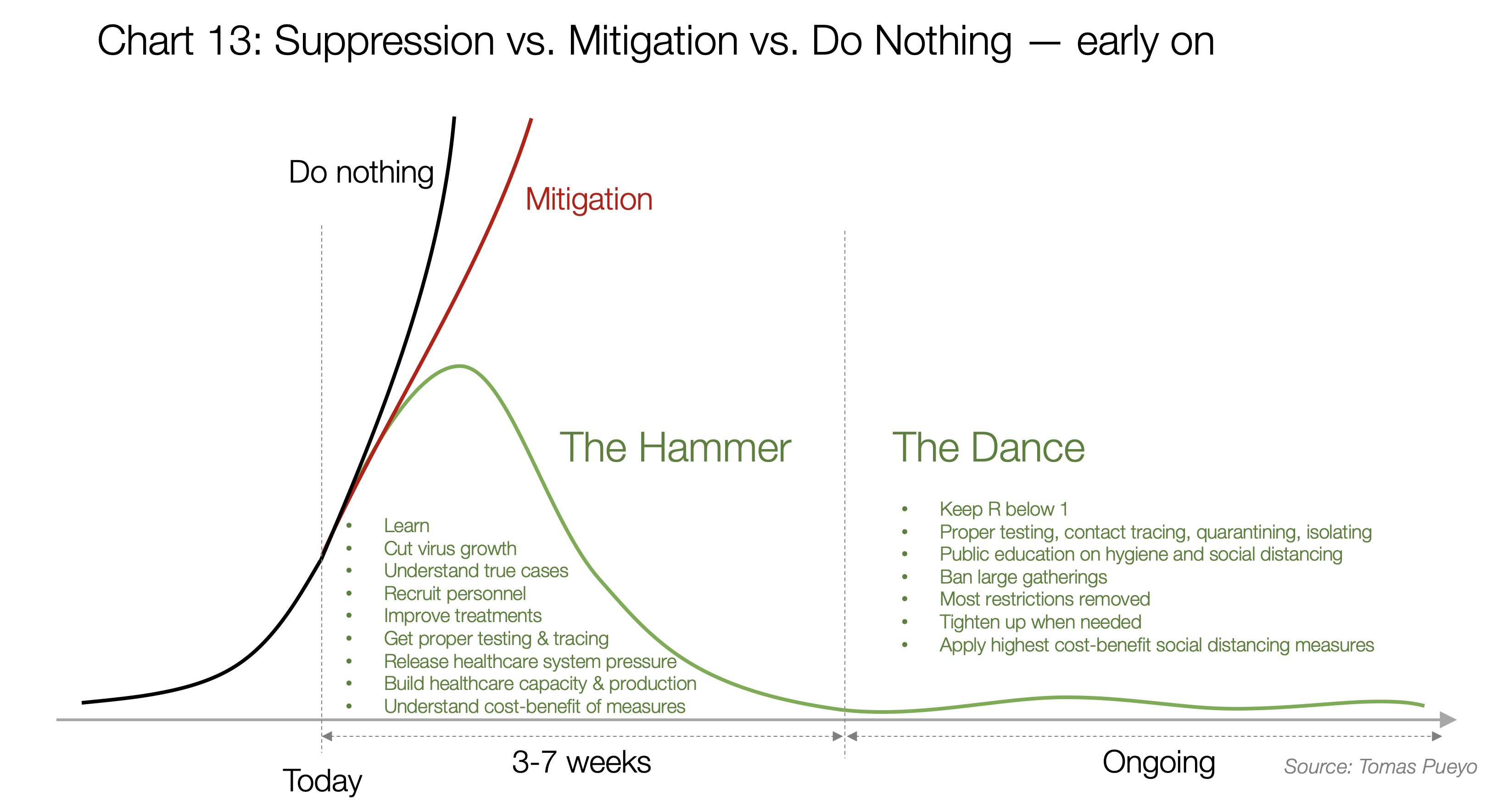
Complete lock down, not the soft ones like Italy, but a stringent one can cut the transmission rate to almost nil. That would give us time, and time is gold. Why?


Sure we cannot lock ourselves for months and let the economy die. Good news is, if we act now, it won’t take months. With government help, within weeks 

  • We can develop faster testing method, conduct massive testing and quarantine potential candidates. 
  • We can train people to identify symptoms early and isolate them. 
  • We can educate people on personal distance, mask wearing, hand washing and disinfecting spaces. 
  • We can also build more facilities for treatment. 


By flattening the curve we can make sure that the hospitals are not running out of their capacity. 
It will give us time to know our enemy and eliminate it with minimum casualty.
Social distancing is not just a theory, it works. Check the simulation by Saptarshi Das
a close up of text on a white background
REF: https://www.linkedin.com/posts/saptarshiprofile_socialdistancing-modeling-simulations-activity-6647500610230988800-2px6


REF# https://medium.com/@tomaspueyo/coronavirus-the-hammer-and-the-dance-be9337092b56

As we slowly release the restrictions after a month, we walk out into a new world. More hygienic, less mass gatherings, stricter travel regulations…but life will go on and slowly even the economy will recover. And maybe by then we would have a medical breakthrough. 

Hopefully this new world would be a better world where we realise the value of life and nature. Hopefully we will slow down and take a break from the rat race. As we accelerate the Global Warming and melt the polar ice, as we keep spreading into remote corners of the globe, we never know which new and deadly creature is lurking in the dark. 
 COVID-19 just a mild warning. We better learn.

For the moment, stay at home… save thousands of life!


REF:
https://www.technologyreview.com/s/615375/what-is-herd-immunity-and-can-it-stop-the-coronavirus/
https://medium.com/@tomaspueyo/coronavirus-act-today-or-people-will-die-f4d3d9cd99ca
https://medium.com/@tomaspueyo/coronavirus-the-hammer-and-the-dance-be9337092b56
https://theprint.in/opinion/current-rate-india-30000-covid-19-deaths-may-no-hospital-bed-june-data/385386/?fbclid=IwAR1xO3W9EgL3GcYyxw2Niq4N5Sih3yhFEnYgWgFy1hOB9-PVVbL_bqpSzQc
https://www.hindustantimes.com/india-news/govt-preps-for-spike-in-covid-19-cases-okays-plan-to-make-more-ventilators/story-uOd5YFyqSGun0FeUf0JzCO.html
https://www.ncbi.nlm.nih.gov/pmc/articles/PMC2738307/
https://data.worldbank.org/indicator/SH.MED.BEDS.ZS


Written by Subhrashis Adhikari

"Engaging and entertaining, this page-turner is remarkable in its narration and will give you a new perspective on various aspects of life. Wellresearched and heartfelt, the encouraging tone throughout the book tries to motivate towards a happier life." - Times of India

Link:


Tuesday, September 10, 2019

Rakhigarhi Woman and the Peopling of India


The genetic study done on Rakhgarhi fossil is finally out. The link for the two new papers are given below:

https://science.sciencemag.org/content/365/6457/eaat7487.full
https://www.cell.com/cell/fulltext/S0092-8674(19)30967-5
To summarise....here is the latest story on peopling of India (considering that the major chunk of this interpretation comes from a single lady in a possible multicultural city)... lets try to fit this puzzle piece by piece...


Puzzle 1 BEFORE THE ERUPTION:
There may have been pre-Toba migration into India, but that has not left behing any significant genetic imprint.
Professor Korisettar would think otherwise. Similar stone tools have been unearthed by him below and above the Toba ash from few places in southern India like Jwalapuram. Middle Palaeolithic tools of 77,000 years old were excavated from below the Toba ash and of 35,000 years old above it. Without fossils there is no way to say they are Homo sapiens. Even if there was an older migration of Homo sapiens from Africa, and even if a lucky few survived the Toba eruption, they did not survive for long as our deadly ancestors were on their way.

Puzzle 2 AFTER THE ERUPTION:

Soon after the Toba catastrophe, the first notable flush of migration took place from Africa. It was called the Great Coastal Migration. This group of people started from East Africa and probably crossed the Bab el-Mandeb, a narrow strait at the southern end of the Red Sea. Then they rapidly migrated along the coast of Indian Ocean to reach south-eastern Asia. This process of migration is not a single journey, but a collection of short expansion from one place to another over generations that took thousands of years.
One of the reasons they stayed close to the coast is the harsh cold climate inland during the ice age. Whenever the climate warmed up these people moved inland following the rivers like Indus. This more sophisticated group of Homo sapiens replaced the ‘original Indians’. Some of the more adventurous migrants took the sub-Himalayan route, while rest kept following the coast. Few of the decedents of this new group of ‘Indians’ (will call them ‘early Indians’, distinct from the ‘original Indians’) then moved towards Southeast Asia and Australia.
Study of genetic data from Indian population reveals that modern Indians share 70 to 90 percent of their mtDNA halogroup with the ‘early Indians’. mtDNA comes from mitochondria, which we get from our mother, and hence it traces the path of the female lineage as males do not transfer the DNA of their mitochondria to their kin (apart from very rare cases). Similarly, the Y-chromosome is transferred from father to son, and traces the male lineage. Interestingly, only 10 to 40 percent of Y-chromosome halogroup comes from the ‘early Indians’. The tribes of Andaman are closest living people belonging to this group. The contribution of the later migrations to our gene pool is mostly from the males.
 Puzzle 3 BEFORE HARAPPA

The last Glacial Age lasted from 29,000 years ago to around 14,000 years ago. The dry coldness of the ice age that had forced humanity into the caves for thousands of years was melting. Out of the caves, into the land, human beings warmed up to new challenges. the earth got warmer, some of the hunters and gatherers turned to a quasi-sedentary agricultural lifestyle. Our ancestors tamed the wild and laid the foundation of our modern civilisation. This phase is known as the Neolithic revolution.
According to the new studies there was a 'second' (there must have been many such phases over such long time that might not have recognisable genetic imprint at the moment) phase of migration in Western India of Iranian hunters and gatherers around 12000 years ago. This is before agriculture was invented in the fertile crescent. They mixed with the locals, probably invented agriculture independently, and then went on the built the Harappan civilisation.

Evidence of early transition to agriculture has been reported from north-central India. State Archaeological Department excavated a mound in Lahuradeva, Uttar Pradesh, in 2006. The mound was believed to belong to local goddess Samai Mai, who helped them with good harvest. The villagers were not far off. Excavation unearthed one of the earliest evidence of agriculture that started 9,000 years ago. Rice cultivation still dominates this part of India. Evidence of early agriculture has also been found from Mehrgarh where it started independently. The early tillers practiced shifting-agriculture. It is still practiced by some tribes of Northeastern India, Odisha, and Madhya Pradesh.

After the decline of Harappan Civilisation these group moved east and south and mixed with the indigenous people and forming the Ancestral South Indian group, or ASI...

Puzzle 4 AFTER HARAPPA

No civilisation can grow forever. Every civilisation has its weak points. Harappan Civilisation had many, especially the over dependence on monsoon and trading. The seed of the civilisation that was planted 9000 years ago in places like Mehrgarh, Bhirrana and Rakhigarhi have finally reached a saturation point. With the predictable monsoons becoming unpredictable, and the fall of key trading partner Mesopotamia, the weak points were giving away due to the burden of rapid urbanisation and growing population. The experiment with civilisation cannot be considered a failure as it survived for thousands of years. The Early Harappan civilisation lasted from 7500 to 4600 years before present. The peak of the civilisation was between 4600 to 3900 years ago. The record of the Mature Harappan phase can be found in the fortified cities of Kalibangan, Banawali and Rahman Dheri. The late Harappan phase lasted from 3900 to 3300 years before present. The rivers were drying up and the main trade partner Mesopotamia went into decline post Sargonic conquests. The demand for beads and shells collapsed rapidly. In Chanhu-Daro (Sindh, Pakistan), a Late Harappan site, hundreds of abandoned semi-finished long-barrel carnelian beads were unearthed. These once precious items, that were the primary drive for the local economy, have suddenly lost their worth. In Mohenjo-Daro a skeleton has been found in a street, called as Deadman Lane by archaeologists. There are many sites that have been completely abandoned. These are signs of stress in the late Harappan society indicating collapse of civil order.

According to a paper published by Dr. Anindya Sarkar in Nature in 2016, the Harappan civilisation continued to flourish even after the decline of monsoons around 7,000 years ago. The crop patterns shifted from large grained cereals like wheat and barley to drought-resistant small millets and rice. The later crops has lower yield and thus in the later stages of Harappan Civilisation the large central storages were replaced by individual household based crop processing and storage system. According to Dr. Sarkar, this might have resulted in gradual de-urbanization rather than a collapse. As the cities started to get decentralized, the western sites were abandoned, and the population started to move towards east. The people of Indus had to interact with those living in Ganges plain, incorporating their culture, pottery, and language. After a bold experiment with urbane lifestyle they turned back to more stable agriculture. They diffused with the rest of India, but their journey continued.

4000-year-old Harappan Civilisation woman did not have a particular DNA called R1a1. What is so special about this gene? This gene is common in ANI population, who received it from the pastoralists of the Central Asian Pontic steppe region, the grasslands located between the Black Sea and the Caspian. ANI is dominant in the modern North Indians. This would mean that there was another phase of migration from Iran into India after the decline of Harappan Civilisation.

Puzzle 5 MUNDA MYSTERY

This piece is related to the Austro-Asiatic group. The people speaking Austro-Asiatic language are found in both India and South-East Asia. What is the connection between the Indians and South-East Asians? Around 117 million speak Austro-Asiatic tongue. In India they live in Andaman-Nicobar, Chota-Nagpur (Munda) and North East India. This language is distinctly different from the more commonly spoken Indo-Aryan or Dravidian language. Austro-Asiatic group is genetically identified from the Y-chromosome lineage (for example O2a1-M95 if you are really interested) found on both sides of the Bay of Bengal. There are two way of explaining this distribution. Either the group originated in India and then spread towards South-East Asia and Australia. Or, alternatively, the group originated in South-East Asia around 20-40,000 years ago, within the population of people who went there during the Great Coastal migration. There was a later backflow of this group into India around 10,000 years ago, just after the Last Glacial Maximum. Some studies suggest a later migration around 4,000 years ago. Whichever story one likes to believe in, it is certain that there is an intimate relationship between the Indians and South-East Asians, a connection that will last well into the modern era.

Puzzle 6 MODERN INDIANS
Modern Indian population is a mixture of ANI and ASI, though ANI is still dominant in North and ASI in South. We are made of all those migration events, and can hardly claim to be pure race....like no one else in the world. The free mixing, however, did not last long. Caste system became rigid around 2100 years ago and people stopped mixing freely....This corresponds to the time of Saka invasion, later followed by Kushans...


There have been migration into India of different groups of people from the West, and also from the East. Whether Aryan language was brought into India, or spread from India can be debated, but not the diversity in our genetic pool. I am sure there must have been mixing of different cultures that resulted in rise of ancient India and its achievements. India assimilated the knowledge of the migrants at different phases and in turn contributed to the global knowledge. We can see the exchange of ideas in the similarity between Indian and Iranian mythologies. Indian Asura was Ahura for the Iranians. The enemy of Vedic people was the god of the Zoroastrians of Iran. Interestingly, Daevas, which sounds like Devas, are the enemies of Zoroastrians. Daevas originally meant the shining ones. Later, Daevas became younger gods or wrong gods. The English word devil has its root in the word Daevas. The cultural exchanges and migrations have made the sub-continent a melting pot of different genetic pools leading to the colourful diversity of India, something we must proudly celebrate.

Written by Subhrashis Adhikari
Author of 5 Questions of the Inquisitive Apes


"Engaging and entertaining, this page-turner is remarkable in its narration and will give you a new perspective on various aspects of life. Wellresearched and heartfelt, the encouraging tone throughout the book tries to motivate towards a happier life." - Times of India


Thursday, September 21, 2017

Decoding Happiness

Search the internet and you will find thousand advices that are suppose to make you happy, from buying a cat to donating an organ. Obviously, happiness is something that is damn important to all of us. But, like the “Holy Grail”, the search for eternal happiness has eluded us. Web defines happiness as “state of well-being characterised by emotions ranging from contentment to intense joy”. I know this definition is open to a debate, let’s just pretend it is true. But the real questions are - why is happiness so important to us and what make us happy!


In no other era in the history of mankind did we have so many reasons to be happy than the one we are living in. Recent statistics, including the one by Steven Pinker, shows that violence is at an all time low. There is dramatic reduction in war deaths, domestic violence, racism, rape and murder globally (Figure 1). For the first time ever more people kills themselves then getting killed by others. World energy consumption, an indicator of our lifestyle, is also increasing exponentially (Figure 2). Energy consumption increased six times since 1960, while the population grew just 2.2 times. The middle class now has more luxury than a Medieval king. With all the reasons we have to be happy, are we any happier?


Figure 1: Decrease in deaths due to conflicts. 


Figure 2: World Energy Consumption by Source, Based on Vaclav Smil estimates from Energy Transitions: History, Requirements and Prospects together with BP Statistical Data for 1965 and subsequent years. [http://www.doomsteaddiner.net]


Figure 3: GDP vs per capita power consumption. [http://www.ourenergypolicy.org]

While there is a direct correlation between GDP and per capita energy consumption (Figure 3), the relation between Human Development Index (HDI) and per capita energy consumption is a bit tricky (Figure 4). HDI is calculated from various factors including life expectancy at birth, years of schooling, and per capita gross national income. Overall the HDI gets better with per capita energy consumption. However, there is a lot of scatter at the lower energy consumption area, and above a particular amount of energy consumption it does not improve the HDI. While poverty does indeed make us unhappy, wealth does not necessarily make us happy.


Figure 4: HDI vs per capita power consumption. [http://www.ourenergypolicy.org]

Surveys done over time in developed countries have shown that, despite increase in income, people are not getting happier. Once the basic needs are fulfilled, money doesn’t really make you happy. People are in fact getting lonelier and depressed. As a result, suicide rates are increasing at an alarming pace (Figure 5). Self harm is the leading cause of death in today’s world (Figure 6). India has one of the highest suicide rates in the world (Figure 7) and it is going to get worse unless something is done. Despite the luxuries, why is happiness eluding us?


Figure 5: Increase in global suicide rate (https://www.vitamindwiki.com/)


Figure 6: How we die.

Figure 7: Suicide problem of India.

In her paper ‘Money Giveth, Money Taketh Away- The Dual Effect of Wealth on Happiness’ published in 2010, Quoidbach et al. demonstrates that ‘having access to the best things in life may actually undercut people’s ability to reap enjoyment from life’s small pleasures’. She came to that conclusion after two different experiments. In the first experiment she found out that wealthy people savoured chocolate less than the less wealthy ones. In the second experiment one set of people were primed by showing them pictures of money, while the other was not. Despite similar economic background, those who saw pictures of money before tasting chocolates savoured the chocolates less than those who were not shown pictures of money. Despite some odd possibility of alternate explanations, like people lost apatite for chocolates after seeing money and thinking of germs, I believe her results were right. It was not just her experiments, but the results of a survey done in US (Figure 8) and some other countries have shown that increase in income is not making people happy. The results are not surprising if one understands what happiness is. 


Figure 8: Consumption and happiness in US.

A bacteria in the soil in your backyard can actually make you happy (read get you high). The culprit here is a bacterium named Mycobacterium vaccae. This was discovered quite accidentally in 2004 by an oncologist at the Royal Marsden Hospital named Mary O’Brien. She was injecting lung cancer patient with serum from Mycobacterium vaccae because the bacterium was thought to have immune boosting response on patients. While it failed to heal the cancer, instead it made the patients happier and improved their lifestyle. It has been found that bacteria and bacterial products can have effect on brain and the neural pathways in a way that it affects human behaviour. That is how our emotions work. It is controlled not by the external situation you are in, but by your internal biochemistry. 

Chemicals inside you effect your emotions, external factors can only activate those chemicals. Nicole Lazzaro explains that there are four different chemicals released by the brain (neurotransmitters) that can make you happy - dopamine, oxytocin, serotonin, endorphins. Dopamine is released on anticipation of happy event or stress. It controls human emotions, including desires, achievements, pleasures, mood, sleep and happiness. Oxytocin, also known as the “love hormone”, is released by the pituitary gland, especially when one come in close proximity to another person. It sometimes has the affect of falling in love and is also called as the “cuddle hormone”. It helps in relationships and bonding and the resulting feeling of happiness caused by oxytocin secretion is different from the happiness due to pleasure or achievement created by dopamine. Serotonin’s affect on happiness is debatable, however it has been proven that this hormone helps us in learning. Some people claim that it affects mood, and lack of it can make one feel low. Endorphins are known to mask pain and discomfort. They can be released during vigorous exercise and lead to an effect termed as “runners high”. There must be several other chemicals that affect our mood than the four described by Lazzaro. The secretion of these chemicals may or may not be caused by external situations. It can be artificially triggered by drugs or meditation. And, more importantly, it does not depend on the amount of energy you consume, or how luxurious life you live. Instead, it depends on your expectations - the deviation of what you get from what you expect. Unfortunately, when a person gets richer, his or her desires and expectations also rise. Thus, soon the difference between expectations and happiness reaches the base level. Psychologists call it “hedonic treadmill” affect.

Happiness is not external, but internal. It is a result of trials and errors of millions of years of evolution, just like the ones that made giraffe’s neck long. Professors Meike Bartels and Philipp Koellinge have found in 2016 the genes that might be responsible for happiness after studying DNA samples from 298,000 people from around the globe. They found that prevalence of FAAH gene, which makes a protein that affects feelings of pleasure and pain, correlates fairly well with “happiness” of different countries (Figure 9). Some research even claims that happiness is 50% genetic. If evolution indeed favoured happiness, the question is why?


Figure 9: Correlation between FAAH gene and happiness (http://www.dailymail.co.uk/sciencetech/article-3559114/Is-happiness-DNA-Study-finds-genes-affect-mood-prone-depression-neuroticism.html#ixzz4tEq7nVhd )

According to evolutionary psychologists like Robert Cummins of Deakin University of Melbourne happiness, just like the negative emotions of fear, anger and disgust, evolved because it gave us adaptive advantage. Negative emotions are stronger because it keeps us alive. Fear helps run away from predator, anger helps us beat our opponents and disgust helps us avoid poisonous food. Experiments done by psychologists Daniel Kahneman and Amos Tversky demonstrated that ‘pain is more urgent than pleasure’. Once we are safe, however, happiness increases our want to survive. Fredrickson’s “broaden and build” theory propose that happiness helps us build resource and store for the future. If we were not happy eaters we would have starved to death, if we were not happy ‘maters’ we would have died long before killing the beautiful dodo birds. We are not going to survive for long if we become equally happy to see our enemies as we are when we see our friends. Positive feelings like happiness change the way our brain works and helps us gather more information. Happy people are also healthier. In short, happiness helps us survive.

While small wonders like a child’s smile, pleasant weather, a birds song, the snow capped peak, the green forest, the blue sky, food, beer and sex, can make us happy, we somehow end up confusing ourselves asking the question, ‘what makes us happy?’. Even the religions that guarantee happiness have no unique solution. The ancient philosophies of Asia declared renouncing materialism makes one happy. The idea being to reduce expectations, and thus increase the gap between what you want and what you get. Thus one would be happier. Try poverty when you have hungry mouths to feed. The medieval philosophy of West and ‘Middle-West’ (I prefer it to the term Middle-East) goes one step further and proclaims that our life is a result of sin. Death is the only way to happiness. That idea is definitely not for me. After the Renaissance people started to reject the idea of being controlled by an invisible force and started to believe in free-will. Individualistic happiness gained importance. As economies of countries grew stronger, materialistic happiness ruled the mind. The new model for strong economy was to spend more. So you had loans and credit cards along with the luring malls to make you happy. It does make you happy, but only for a very short time. All it does, is raise your expectations. We now know what rising expectations does to happiness. 

In this growing materialistic world, how do we become happy? Maslow would say self actualisation, a priest would say salvation, Buddha would say renunciation. Most of them would be about reducing expectations. There are other things that has been proven to make a lot of people happy. It is listed in Figure 10.

Figure 10: What makes us happy.

Science has finally found the pill that fills your life with happiness. The secret pill they called ‘Love’. As if we are supposed to be surprised. People who are in a stable+happy+long relationship are the people who are happy. Love can even erase unhappy childhood memories. And sometimes, experiments showed, replace unhappy memories them with happy ones. Altered reality makes you unknowingly lie about your past. But then lying isn’t a bad thing when it makes you happy without harming anyone. People in love also live longer and healthier. The best way to be happy ,then, would be to love as many people as you can, but do not expect much in return.


Tuesday, April 18, 2017

Post-Truth Era and how to spot a FAKE?


The Middle Ages have often been termed as the Dark Age. It was a time when religion reached its peak of obscenity. Ruthless battles were common sight of the era (though there were places in the big world where peace still prevailed). Then came the age of enlightenment. Technology grew exponentially and science trumped over prejudice, or so we thought. The darkness never dies. Pride and prejudice are the lifeline of darkness, and they will live as long as humanity does. At the heart of pride and prejudice lies ignorance. 'What’s wrong with being ignorant?' you might ask. The irony of being ignorant is that most of the time you don’t know it.

"The irony of being ignorant is that most of the time you don’t know it."

Majority of American’s think that 33% of their population are immigrants. The real number is just 14%. Many Indians believe that the Muslim population in India is over 30%, The real number is only 14.2%. Wrong statistics with hidden agenda are floating around in Facebook and WhatsApp. If you tell the people who believe in these mythical numbers that they are wrong, the reply is either the government cooked up the numbers or they don’t care because they are right (http://www.economist.com/news/finance-and-economics/21699455-dealing-problem-public-misperceptions-ignorance-isnt-bliss). Ignorance gives rise to conspiracy theories. And there in lies the problem. Ignorance isn’t always a bliss.

‘Post-truth’ is Oxford dictionaries word of the year for 2016. It is an adjective meaning, "Relating to or denoting circumstances in which objective facts are less influential in shaping public opinion than appeals to emotion and personal belief”. Politicians funded news channel, rise of social media and internet, insecurity resulting from declining economy and rising terrorism and polarisation of political ideologies are few of the many reasons for the birth of post-truth era. In this era the once good words like being ‘intelligent’ or ‘liberal’ suddenly became a curse, and are now preceded by the word ‘pseudo’. These words are commonly used to describe people whose logic you do not agree with, but you are unable to prove that he/she is wrong. Why do we behave this way?

"It is a normal human tendency to only verify information that does not fit our prejudice. When it perfectly fits the bill, we tend not to check the facts."

Greylag goose brings back her displaced eggs to the nest by rolling it with her beak and neck. Now, if you keep a spherical object similar to her eggs, like a ball, nearby she would roll it into her nest too. She cannot help it. Human beings too have their eggs of faith. When someone puts another object, no matter how fake, that fits your faith near you, you are going to roll it into your nest. We just cannot help it. It is a normal human tendency to only verify information that does not fit our prejudice. When it perfectly fits the bill, we tend not to check the facts. That's when we tend to believe a lie. And when a lie is fed over and over again it becomes a truth. Post-truth politics has played its role in Brexit referendum and US presidential election. Westerners believed when Tony Blair said Iraq has an advance chemical weapon programme meant to destroy them. US and Russia are probably killing more innocents in Syria than ISIS, but many are fed to think that the war is justified. Anti-intellectualism and populism are on the rise in Poland as conspiracy theories exponentially grow. Back in India character assassination posts using morphed images of Gandhi and Nehru has gone viral. It is easy to fall for misinformations.

Misinformations are used to trigger riots and wars. Misinformations feeds racism and creates an industry like ‘fair and lovely' out of it. Misinformation creates intolerance, ISIS being a live example of that. But ISIS is not the only example. Marshal Khan was tortured, shot at, and even after he died his dead body was beaten to a pulp by his fellow students in Abdul Wali Khan University. His guilt? He was secular and liberal and thus, according to the murderous mob, blasphemous. 28 years old Nazimuddin Samad, an atheist blogger, was hacked to death in Bangladesh because he wrote what he felt was right. Srinivas Kuchibhotla, a 30 year old Indian, was shot in Kansas USA because he was not an American working in America. Pehlu Khan, a 55 year old man from Haryana was murdered by ‘gau-rakshak’ (cow protector) mob in Rajasthan just because the mob suspected him and his friends of illegally transporting cows. Ignorance has taken more life than any weapon in history of human civilisation, how can it be a bliss?

"Ignorance has taken more life than any weapon in history of human civilisation, how can it be a bliss?"

Is it possible to get rid of ignorance completely? The capacity of our human brain is limited.  Large Hadron Collider can churn out 30 times more data in a year then the total storage capacity of our brain. There is only so much we can store. In this age of information we need to depend on the knowledge of others to believe in something. Neither do we have money and time nor the skills required to verify each and every information that comes our way. If you question everything then you have nothing to begin with. We believe in evolution, plate tectonics and big bang because we believe in the word of someone else. These are not even facts, but theories that we have never personally tested. When an orthodox Christian tells that evolution is fake because he/she believes in the word of someone else who wrote the bible, how do we say the he/she is wrong? 6000 years ago some pretty reliable persons said earth was flat. We ‘saw’ it and believed it. But they were wrong. Newton, a pretty reliable physicist in my opinion, told us how gravity works and we believed him. But he was wrong. It is never an easy thing to separate facts from fiction. There will always be things we can never verify. It is a slippery ground. But that does not mean you will let others exploit your ignorance. Luckily, there are few things you can do. Question the authenticity of the source, especially before you plan to share an information with others and potentially spread a lie (very well knowing that even a reliable source like Newton can be wrong). The next thing would be to question the motive behind the information you received (REF#How to tell truth from lies, O’Callaghan 2017). Is it trying to spread hatred? Is it politically motivated? Spent some energy thinking before you act.

"In this age of information we need to depend on the knowledge of others to believe in something. Neither do we have money and time nor the skills required to verify each and every information that comes our way. If you question everything then you have nothing to begin with."

While it is not always possible to verify facts, there are times when we also need a bit of fiction to understand the bigger truth. While interpreting seismic data to find oil we Geologist have many interpretations. All interpretations are wrong, only some are more useful than the others. In science we often use simplifications that deviate from truth, we call them assumptions, to deduct a bigger truth. If we do not use assumptions and try to put in all complex ‘true’ variables, we will never come to an answer. These fictitious falsehoods are important as they help us dig out the truth. There is no light with out darkness…and no darkness without light. One cannot live a life holding on tightly to the truth. One needs to be flexible. A wise person understands when wrong is really WRONG. The trick is to have an open mind and challenge the prejudice. Ask yourself if you believe in something just because you were told by people close to you, or you actually spent some time thinking about it. It is OK to be a skeptic, but never be a cynic...because ignorance is a bliss only if you know you are ignorant.


"It is OK to be a skeptic, but never be a cynic...because ignorance is a bliss only if you know you are ignorant."