ABOUT THE AUTHOR

Know more about Subhrashis.

JOURNEY OF SURVIVORS

Know about the unknown history of India. Click to Purchase.

5 QUESTIONS OF THE INQUISITIVE APES

Want to unveil the mystries of the universe? Want to know yourself? Want to be happy? Click to buy.

FOLLOW ON FB

Catch the latest posts.

FOLLOW ON INSTA

Keep up to date with the latest pictures.

WHATSAPP CONNECT

Talk to Author directly

Welcome to KHOJ: The search to know our roots and understand the meaning of our existence.

Prejudice is the biggest problem in the society. It can be it in terms of religion, cast, sex, skin-colour, status etc. Prejudice can also be in form of the feeling that human beings are the greatest creation, or even patriotism about artificially created borders. The motto of KHOJ is to gain knowledge and break that prejudice. But there is a word of caution for the readers. To break the prejudice KHOJ might throw upon you the concepts it believes in. If the reader believes on KHOJ’s perception without question, then KHOJ itself might incept a prejudice in the readers mind thus failing in it own motto. KHOJ is trying to break its own world of prejudice, but at times that prejudice might get reflected in its writing. Please do challenge them.

Saturday, July 2, 2016

How I got Leh'ed: Day 5,6 & 7 Nubra-Pangong

After four days of acclimatisation we began our real trip on Day-5.


Rigzin was on time as usual. We started early at 8:30 am from The Auspicious Hotel in Leh.

Rigzin gave us two Inner Line Permit forms (ILP) to fill.

Make sure you carry enough money from Leh as there are no ATM’s in Nubra. It would also be a good idea to carry water bottles as their price will double where you are heading.

On our way we were stopped by the army at a checkpost. Rizgin told something to the guard in local language and we were good to go. He did not submit any form there. When asked what happened he said that a different form was required here which he did not have. Surprised, we asked why did they let us go? Rigzin smiled and revealed that he told the guards that the form is in the car behind us. It is true that the car behind us did have the form. But that form had nothing to do with us. I wondered what would have happened if we were caught. Would we still be driving to Nubra? But then, Rigzin has over 12 years of experience, he knows exactly what he is doing.

It was a steep rise through curved roads. A signboard said that the road was open only till 10:30 am because of ongoing constructions. We took a break at South Pulu (15300 ft). Rigzin went and submitted the first ILP form, and then we continued on our journey. After some time we crossed the snow-line and patches of ice started to appear on the sides of the road. Snow increased as we reached closer to Khardung la.


Finally we arrived at Khardung la. The board there claims it to be the highest motorable pass in the world at 18380 ft. It is actually at 17,582 ft (5,359 m), lower than the board claims. It is not the highest motorable pass in the world. It is debatable which one really is the highest. One website claims: “The road to Uturuncu above col is situated in Potosi, Bolivia which is actually considered as world’s highest motorable road at a staggering altitude of 5,777m or 18953ft.”


Never-the-less, the altitude is still very high and the air was thin. A board at Khardung la warned us not to stay here more than 20 minutes. Be quick to click photos. You will find more ice as you drive down. There is a toilet at Khardung la. But very smelly and there is a long queue. However, most toilets are similar. If you aren't comfortable in the open then you better try this.


14 kms from the pass there is another place where the ILP form was submitted. The landscape changes once you cross the pass. The landscape changes because the geology changes. From the Ladakh Batholiths we were now passing through the Khardung volcanics. From there we moved to the Shyok Formation. Shyok Formation is not continuous, but occurs as thrust slices and lenses. It is described as an ophiolitic melange and it consists of serpentinises and ultrabasic rocks intercalated with volcanoclastics and sedimentary rocks. Both Indus and Shyok suture zones represents two northward dipping subduction zones of Cretaceous age. Shyok ocean closed when Ladakh arc and Karakoram block collided to form the Shyok forearc ophiolite (between 74 Ma and 97 Ma). Later the Indian plate collided with Ladakh arc (50-60 Ma) forming the Indus suture.


Instead of 50 shades of brown you see a big white valley, occasionally disturbed by patches of green. Shyok river braided through the miles of white. North of us are the mountains made of Karakoram Batholiths. Nubra valley lies at the foot of Karakoram Range. Temperatures and milder than Leh and you do see a lot more green. ‘Nubra’ itself means ‘garden’. There are apple and apricot orchards around. It was through this valley that the traders of the legendary silk route once travelled. It opened to tourists only in 1994.


So engrossed were we in the beauty of the surroundings that we did not realise when we reached Diskit. Diskit Gompa is an old monastery that was founded by Lama Shereb Zangpo, a disciple of Tsongapa (Tsong Khapa), founder of Gelugpa, in 1420. The monastery belongs to the Gelugpa (Yellow Hat) sect of Tibetan Buddhism. It is a sub-gompa of the Thikse gompa.


The monastery has preserved arms and head of a anti-Buddhist Mongol demon (probably a man who came from Mongolia) who used to terrorise the natives. According to the myth he was killed and resurrected several times.

An impressive 32m high statue of Maitreya Buddha has been built here in 2006-2010 that looks down the Shyok river. The statue looks so majestic with the blue sky in the background that even the Karakoram ranges appears small. Statues of Tsongapa, Gelugpa, Buddha and Guru Padmasambhava (an 8th-century Indian Tantric Buddhist master, also known as Guru Rinpoche) is present inside the monastery. You have to climb the stairs to reach the room.

If you want to go to the toilet this is a good place. Just below the monastery opposite Diskit Gonpa school there are restaurants and shops with good toilets. Ask your driver.

Our next stop was at Hunder, 15 minutes drive from Diskit. The village of Hunder, often called the desert in the sky, was made famous by the movie Dil Se. We had tea in cafe RCC. It is a wet canteen which proudly says ‘all persons are allowed’. After having our cup of tea, when the sun was less hot, we proceeded towards the sandy cold desert. A small fee of 30INR was required to enter the desert.


If you are interested in the double hump bacterian camel ride go early. There are only 50 semi domesticated camels in this place and over 200 in entire Nubra Valley. They found a new home here via the famous silk route. These camels can withstand very low temperatures, upto -40 deg C,  and are very hardy with our much disease and high feed conversion efficiency. They can graze by themselves without any supplementary feeding. Their main importance as the beast of burden has reduced with advent of cars and better roads.
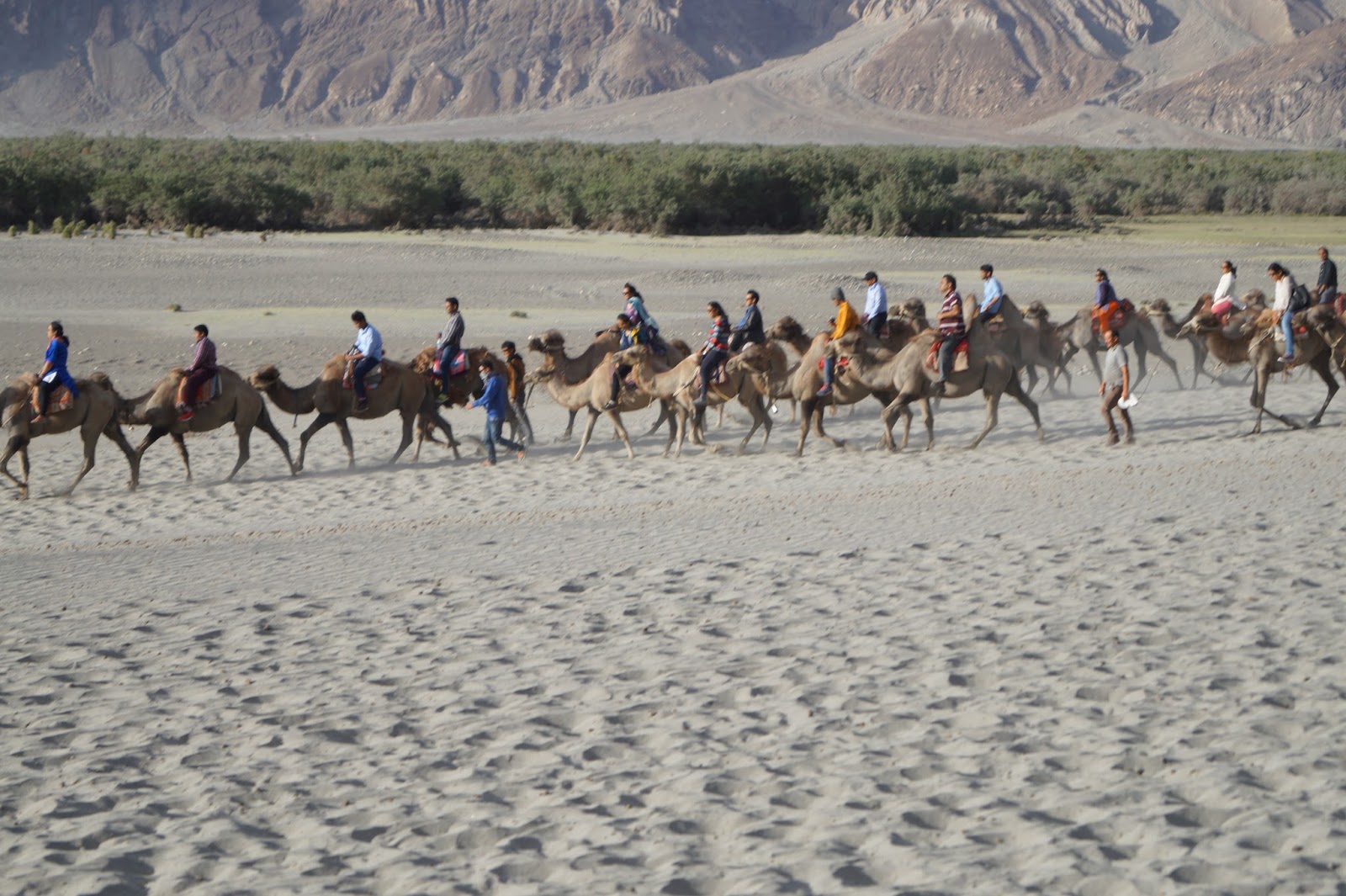


There is a huge queue for the ride. The cost is 200 INR for 15 min. When we went they said that they are not giving tickets any more because there were too many tickets sold already. After lots of trouble we did managed to get the tickets. After breaking the back of the poor camels for 15 minutes and promoting their life of slavery we drove to our hotel- The Snow Leopard. For the camel owners it is just a 4-5 month season. Rest 7-8 months they make sure the camels stay alive. The cost of keeping them alive comes from the money we pay them. Tourism is the reason why these camels are alive in the first place.


The Snow Leopard is a nice hotel. It is big, clean and has spacious rooms. The bathroom is also neat and big. Do not expect to find any mobile towers in this place. We spent our night in the comfortable rooms overlooking the hills.


If you are not interested in visiting the last village in a particular direction of a man made border you can head to Pangong Tso the next morning. Else you can stay one night in Turkruk village. There is an interesting story about the origin of the village. The native name of the village is Dhuk-Dhuk, meaning settling down. According to local folklore, there was a boy and a girl who camped here 1100 years ago. They fell in love and decided to settle down in this beautiful place. That’s how  the village got it’s name.

Next day we started at 9 am. Start early because the road to Pangong might get blocked by river water coming from the melting ice. As the temperature rises and more ice melts, the water level in the river rises as well. Our first aim today was to cross that point in the road before the river does. The 193 kms stretch from Nubra to Pangong is the most difficult drive in this tour so far. It is recommended to know the road conditions before going this way. You have to cross small streams and the road in most places is bouldery. The easier way is to go back to Leh and take Leh to Pangong route. However, it would cost you an extra day.


After some time we hit a green patch, literally. It was Leh forest in Agham. On the way we stopped at a place for photo. But Rigzin was nervous. He warned us that we need to move fast if we have to beat the river. We crossed a river that flowed over the road, but not at dangerous levels. Excited, we asked Rigzin if we made it. He smiled and said, that was not a river. It is more like a drain. Our destination is still far away. Now we were driving almost through the river bed of Shyok. Finally we did cross the danger point, only to realise that there are more than one such points. One by one we crossed all such points. We did manage to defeat Shyok river. By we, I mean Rigzin. In the excitement to cross the river I did not realize that we crossed the Karakoram fault.

On the way there is the 17th century Taktse monastery.  We took a break for lunch at Tangtse, which we reached at 1pm. It was at 14106ft. Maggie is the only thing you can eat here. We asked for egg omelette separately.

We were lucky to meet a Himalayan marmot (pheya in Ladaki) couple on the way, along with cows, pony, sheep and donkeys

We reached Pangong at 3:30pm. There is an entry fee off 10 per person and you need to submit the ILP form. The first view of the deep blue salty lake made us all go ‘WOW’. The Mars like reddish brown mountains sandwiched between deep blue lake and deep blue sky is one of the best sights I ever had. The color of the lake changes with time. The lake is bluest when the sun is brightest. One can spend hours just by sitting at the side of the lake.

One interesting fact about the lake is that even though the water is salty and has no life, there are shells of freshwater species along the shores. This was first observed by British explorer Godwin Austin in 1863. The lake was once a freshwater open-lake, and the water was drained out and re-filled by melting glaciers. A big fan deposit blocked the water exit path and naturally dammed the lake. since then evaporation has turned its water salty. 


The movie ‘Three Idiots’ made this place famous. The three idiots place is a crowded place, though you can enjoy horse ride, tea, coffee, and take  a chance at shooting an arrow. The view is equally beautiful from all the places along the 40 kms stretch of the lake on the Indian side. The rest 3/4 is with China.


We stayed at New Wonderland Tents. For booking contact Norbu at 9469085995. This is amongst the few accommodations that is right beside the lake. On the back of the tents are the snow capped mountains. The price was 4000 including food. We got some discount. Electricity comes only between 7:30 to 11 pm through the generators. No room heater is available for safety reasons. Not that we required it. The tent was pretty warm. Use the toilet waters economically. Water is scanty, and water bottles are trucked from Leh. Per bottle here costs 50INR. The dinner was good. Tawa fry with dal was very good.


Next morning we woke up early to see the sunrise. It happens at around 5:30 am. I was very cold outside, but the sight was worth it. The puri in the breakfast was delicious. Bread does not last long. If you want bread go early for breakfast. When we went, there was none left. 

At 9:30 am we started our journey back to Leh. The valley was on our right, and it was filled with white sand. Soon the valley changed to green as the waters of the small streams gave it life. The grass brought animals like pony, sheep, yaks and marmots to the valley.


On the way we stopped at a patch of ice, as if a small lake was frozen.


We cross the Karakoram fault before Chang La. It is a near-vertical dextral strike-slip fault that was activated recently (between 18-13Ma). Chang La claims to be the third highest pass in the world. 


The road to Leh was blocked because of some ongoing construction. The alternate diversion was in very bad condition. But it is India. Everything is possible. You just have to believe it is possible. While all cars took the bad road, Rigzin gave the workers who blocked the road a bottle of water, and we were let through. Like I said before, drinking water is scarce here. Rigzin knows all the tricks. Down the steep roads we were rapidly losing altitude. Which was a good thing. We were gaining oxygen in return.

We had lunch at Kharu at 2:30 pm. Then we stopped directly at Leh. We were back at Hotel Auspicious.

Click for Day- 8&9

Thursday, June 30, 2016

GET OUT OF COMFORT ZONE

A small talk to the young employees of my office on my journey  towards writing my first book 'The Journey of Survivors'. The aim was to emphasise on 'deliberate practice' to achieve what you want.

Only after I listened to this recording that I realised that I have a funny accent.


Good Morning young people!

And when I say young that includes our CEO. Mayank looks young, doesn’t he?

You must be wondering what I am doing here.
Well…I am also wondering about the same thing more than you.

Devika requested me to speak about my own experiences and how with the help of deliberate practice I managed to end up writing a 476 page book.
She hoped that I would be able to inspire you young professionals.
When I heard that I was like … Really? Me? Inspiring people?
I would end up in the stage revealing my close guarded secret - that I am an idiot.
Now, none of you are telling that to anybody. Right?

Then I realized …. nobody can actually inspire anybody.
Virat Kolhi might consider Sachin as his inspiration….but which young cricketer doesn’t? Not everybody ends up becoming Kolhi.
At the end of the day, it is you who have to inspire yourself. Have faith in yourself, stretch yourself, get out of the comfort zone.
That’s what I did when Devika called me. I felt uncomfortable speaking infront of so many people. I have never done that. I felt so uncomfortable that I said that I am going to do it.


So, let us get back to my book.
A year back when I told my parents that I was going to publish a book they became very excited.
They asked me, ‘What are you writing on?’
I said, ‘History.'
They looked at me, surprised, as said, ‘Have you started taking drugs?’

I don’t blame them. When I was in school I used to run away from history. Before the history exam my brother used to read the history book to me.
I just used to listen to him and give the exam. That’s how afraid I was of history.
Forget history, I was afraid of reading in general. My brother used to give me books to read. I used to turn over the cover and keep it back in the shelf.
That changed when I was in class 10. My brother gave me a book called Illusions by Richard Bach. I don’t know why, but it started liking it. One thing helped – the book was thin. After that I slowly started getting addicted to reading.


Reading is like drinking whiskey. The first time you take the sip you are like ‘yak. You don’t like it. The second time, you feel OK. Soon, after few free drinks, you end up buying your own bottle. It usually ends up with you buying a bar cabinet. For books it is not bar cabinet but book shelf.

So I got addicted to reading. Why?


As we grow we learn from our family, our school, our close people. What we do is we start building walls. We build walls of good-bad, do-don’t, right-wrongs. They create walls of prejudice.
The more walls we build, the more our vision gets narrowed. We look at the world through our narrow prism of prejudice. What book does is help you break those walls. The addiction that I had was not really to reading.
The actual addiction was of breaking those walls of prejudice.

Why am I telling you about this? Because this phase of my life is important; without it I would have never been able to write a book.
How did I end up writing about history?
I was excited about the colour, the diversity and the chaos of India. I was curious to know how we came to be what we are. So I started reading. But unfortunately I was born with a very small floppy-like memory disc.
I forget things very easily.
So instead of just studying I started writing the important points. I realized that writing actually helped me understand things better. I was reading things from different places, I was traveling (I travel a lot), and I was getting a lot of information. When I wrote things down, summed it up, it helped me understand the past in a much better way. I could co-relate things better.

The next step was writing blogs. It was a challenge. I am not very good with grammars. Blogging also meant that I was exposing my ideas to public scrutiny, at the risk of exposing my close guarded secret. The was uncomfortable. It was so uncomfortable that I said I must do it. I started writing blogs. When I wrote enough posts I began to think of a book. Book was a bigger challenge. Writing a book without being an expert on it? That was uncomfortable. I enjoy that stretch. I said to myself, ‘Why not?’ And I ended up writing this book.

At the end there are two things: stretch yourself, and get out of the comfort zone. Those are the two things I deliberately practice doing. Now, this is not a success story because my book is not a best seller…yet. But it is a personal success for me. I gave myself a stretch goal and I achieved it. And more than success, it is a personal satisfaction.

Those are the two things I did deliberately, over and over again. Whenever someone asks me or my boss tells me to do something I am not an expert in, that I feel I might not be able to do, I say I will do it.
If there is one thing you take out of this talk, that one thing is: GET OUT OF YOUR COMFORT ZONE.  It may sound contradictory, but, be comfortable outside your comfort zone.


What I also believe is that there is no one path to success. We all are different and our ancestors understood it. They wrote down paths to achieve salvation. I equate that to success. For the people who are emotional, people of heart, there is Bhakti yoga. With complete devotion to something you believe in you can achieve success. An example would be – Sachin Tendulkar. He devoted his entire life to cricket and he is successful. For people of mind the path proposed was Raj Yoga, or Gyan Yoga. It is about achieving success through sheer knowledge and thinking. Einstein is an example. There is Karma yoga for those in-between heart and mind. They achieve success by following their duties sincerely and honestly. Rahul Dravid is an example. He was not a born talent. He practiced hard and sincerely , but did not devote his entire life to cricket like Sachin Tendulkar. He too achieved success. And finally, Tantra yoga for the eccentric people. These are crazy and creative people, like Michael Jackson. They can do stupid things but still achieve success.

So different people are different and there is no single path to achieve success. But one thing is common in all those who become successful: They stretch themselves and get out of the comfort zone.

Remember, not everybody become successful, but a successful person can come from anybody. It does not matter where you are today. If you stretch yourself you will become successful.

Thank You.


BUY THE BOOK
Buy Soft Bind
Buy Kindle
Check my website

Monday, June 27, 2016

How I Got Leh'ed: Day 3 & 4 To Dah and Back

CONTENT
Summary
Day1: LEH - Do Nothing
Day2: LEH-Around
Day3-4: LAMAYURU
Day5,6,7: NUBRA - PANGONG TSO
Day8: LEH
Day9: TSO MORIRI

Day-3 & 4

It was day 3 and we were ready for more activities. Climbing steps was an indicator of acclimatisation, and it was getting easier. However, since we had a 5 minus and a 70 plus traveller with us we planned day 3 and 4 such that we do not gain altitude.


The plan was to travel to Dah (182 kms from Leh) and Lamayuru (108 kms from Leh)  having similar altitude to Leh (3510m/11520ft). We started at 9am after breakfast. Our car drove through the Indus-suture zone (containing Indus group of rocks). Indus Group is a marine to terrestrial sedimentary deposit that formed in fore-arc set-up as the neo-Thethys closed because of collision between Indian and Eurasian tectonic plates. Towards our north were the Ladakh Batholiths (on which Leh is located) emplaced (102-50Ma) during island-arc magmatism as Indian place subducted below the Eurasian plate. On the way we stopped at Gurudwara Sri Pathar Sahib Ka, 25 kms from Leh. If you are in time you can have awesome roti-sabji (Indian bread and curry) there for free. The gurudwara is maintained by Sikh regiment of Indian Army.

Guru Nanak arrived here in 1517 (his second journey). According to the legends a wicked demon lived here who terrorised the villagers. On hearing about the demon Guru Nanak started meditating. The angry demon threw a big boulder at Guru ji. On touching Guru ji the stone turned into wax. His back got imprinted into the boulder. Seeing Guru Nanak alive the demon kicked the boulder with his right foot, which also sank into the boulder. The demon realised that the man infant of him was no ordinary man but a holy disciple of God. He fell at his feet and begged for mercy. Guru Nanak opened his eyes and asked him to give away his evil habits and serve people instead. The demon did as asked and lived happily ever after.

Imprint of Guru Nanak

Our next stop, magnetic hill, was not far away. Check out the video to see the mystery magic of this place.


From Magnetic hills we drove to the Indus-Zanskar Sangam (confluence) near Nimmu. Indus is green while Zanskar is muddy. Zanskar river gets frozen in winter and this is the starting point for the popular Chander trek up the frozen river.

Looking East. Indus towards left and Zanskar on the right.


One can visit Basgo Gompa & Fort and Likit Monastery on the way to Alchi if there is time. We went directly to Alchi Monastery (60 kms from Leh). It is one of the oldest and finest monasteries of the region, now under ASI protection. It has many Thangkas (Tibeto-Buddhist religious paintings on cloth) dating back to 11th-12th century. 

One if them is the famous Wheel of Life. The wheel is hold by Yama, the god of death. The circle at the centre of the wheel contains a pig (ignorance), a snake (anger/hate) and a cock (desire/lust). They are the root of all evil that keeps the wheel turning. The middle circle is divided into six segments depicting six segments of existence: Devas on the top, followed clock-wise by Asuras, and ghosts. Hell is in the bottom after which there are animals and then humans between animals and Devas.  In the outer circle on the left the monks and lay-folks are moving up on their way to happy rebirth, while on the right the naked figures are being dragged down to woeful rebirths. Outside the circle on the leftist are the twelve casual stated of individuals based on Buddha’s ‘law of dependent origination’ (ignorance, constructing activities, consciousness, name and form, six sensory organs, contact, feeling, desire, clinging, becoming, birth and death). 


There are five temples, each holding beautiful murals. Sumtseg has idols of Avlokiteshwara (bodhisattva who embodies the compassion of all Buddhas), Mayetryee (future Buddha representing hope), Manjushri (goddess of wisdom). The deities wear beautiful ‘Dhotis’. Mayetryee’s dhoti depicts the life of Buddha, the Avlokiteshwara's dhoti shows holy places and royal palaces and Manjushri's dhoti has adepts printed on it. Avlokiteshwara is red, and holds a lotus. He helps suffering beings. Vairocana Temple has the main celestial Buddha representing the Dharma body of historical Buddha. The walls are painted with the five dhyani Buddhas (explained in last post). Lo-Tsawa represents the Tibetan Buddhist texts. Manjushri temple (built in 1225) contains four images of Manjushri. All the four-armed Manjushris holds a sword, a book on top of a lotus, a bow and an arrow. Manjushri is the Bodhisattva of wisdom. He is a white boy wielding a flaming sword that cuts down delusion. Apart from the temples there are amy Chortens. Don't forget to check out the view of the river behind the temple. 


Sumtseg
Celestial Buddha

Manjushri
River behind the temples

This is a good place for lunch. Lots of restaurant. We hopped into the Zimskhang Restuarant. It serves mostly vegetarian dishes. They may have egg and canned tuna as well. Veg buffet is expensive. A-la-carts a cheaper and better option, unless you came down after trekking and is really really hungry. If you do not have your lunch here you have to go to Khaltsi market, on the way to Dah-Hanu . There are smaller shops and mostly thali system.


After having lunch we started our long drive towards Dah to meet Alexander’s kin. Our luck ran out and we were stopped 5 kilometres from Dah. The heat from the scorching sun has melted too much snow increasing the water in the river. Indus has overflowed and blocked the road to Dah. However, we came to know from the locals that we are already into the region where the so called ‘Pure Aryans’ live. We took a difficult curvy road, up the mountain, to reach the village of Sanith. The village consists of 24 houses where the people look and speak a language different from the Ladakis. They are Caucasians and not Mongolians.

These Western Ladakhi people belong to Brokpas or Minaro (native) tribe. They speak archaic Shina language and are identified by their flowery head-dress. They prefer to call themselves ‘pure Aryan’, while some people have claimed that they are Alexander’s lost army. Genetic studies show only a faint Greek connection. ‘Aryan’ is also not a race, rather a linguistic division. Whatever their origin is, the mystery and our romanticism with fair skin and ‘Aryans’ helps them with tourism. Being ‘pure Aryans’ did not attract tourists, rather the tourists made them ‘pure Aryans’.


My driver insisted that they speak Aryan language that is a mixture of Hindi and English. Interestingly, though he understands both English and Hindi, he cannot decipher their language. The good thing is that the villagers know Ladaki, Hindi and English. Which meant that they could explain to us the direction to the pre-historic rock-art. The road block was actually a boon in disguise. If we had gone to Dah we would have never found the rock-art, one of the reason why we traveled so far in the first place.


The rock art happened to be right beside the road for where we took the sharp turn for Sanith village. There is a man made wall of boulders on the side of the road. Climb it and go towards the extreme end towards west. That's where the paintings are. Look for smooth polished surfaces, a sign that the rock surface survived thousands of years since some pre historic artist drew their emotions. Pre-historic hunters and gatherers flourished along the banks of Indus. They have left their mark as petroglyphs over a 150 kms stretch along the Indus bed. It is not just painting, but work of art etched on the rocks. The figures includes Ibex hunting, dancing, caravan scenes etc. 


From there we went back to Nurla for the night stay. We stayed at Faryork Resort (2500INR/night including food) which had cottages right beside Indus river. The resort had good food and friendly staff. Actually one super active staff, while the rest just relaxed.
CLICK FOR TRIP ADVISOR REVIEW


Next morning we started late at 10 am and headed towards Lamayuru. In-between we stopped at Moonland, which appeared like a miracle of Geology. These strange looking rocks are actually paleo-lake deposits. The water of the lake has been uplifted and drained out.

Moonland
Lamayuru is probably the oldest monastic site in Central Ladakh. This place was a holy site for the Bon-chos religion long before Buddhist influence spread along the valley. The monastery originally had five buildings, now mostly in ruins. The surrounding view is awesome. The weathered rugged typography, with houses constructed defying gravity is a special sight. 


On our way back we had lunch at Nimmo. We ate at a special mutton and veg restaurant named 'Jigmat'. Mutton thuppa and mutton momos were awesome. 


Our next stop was at Hall of fame war museum. It consists a bit of Ladakh history and culture, and a lot of military heroics and sacrifices.


By the time we were back at Leh it was evening. It was still brightly lit. The light stays here till 8 pm at this time of the year.

Click for Day 5-6-7
