ABOUT THE AUTHOR

Know more about Subhrashis.

JOURNEY OF SURVIVORS

Know about the unknown history of India. Click to Purchase.

5 QUESTIONS OF THE INQUISITIVE APES

Want to unveil the mystries of the universe? Want to know yourself? Want to be happy? Click to buy.

FOLLOW ON FB

Catch the latest posts.

FOLLOW ON INSTA

Keep up to date with the latest pictures.

WHATSAPP CONNECT

Talk to Author directly

Welcome to KHOJ: The search to know our roots and understand the meaning of our existence.

Prejudice is the biggest problem in the society. It can be it in terms of religion, cast, sex, skin-colour, status etc. Prejudice can also be in form of the feeling that human beings are the greatest creation, or even patriotism about artificially created borders. The motto of KHOJ is to gain knowledge and break that prejudice. But there is a word of caution for the readers. To break the prejudice KHOJ might throw upon you the concepts it believes in. If the reader believes on KHOJ’s perception without question, then KHOJ itself might incept a prejudice in the readers mind thus failing in it own motto. KHOJ is trying to break its own world of prejudice, but at times that prejudice might get reflected in its writing. Please do challenge them.

Sunday, June 26, 2016

HOW I GOT LEH'ED: Day 2 Around Leh

CONTENT
Summary
Day1: LEH - Do Nothing
Day2: LEH-Around
Day3-4: LAMAYURU
Day5,6,7: NUBRA - PANGONG TSO
Day8: LEH
Day9: TSO MORIRI


Julley! It is the magic word of Ladakh which is used to greet people. That would be the first, and probably the only native word you will learn, apart from ‘tso' that means ‘lake’ and ‘la’ meaning ‘pass’. It is day two and finally we can get out of our rooms.


The second day was kept for half a day sight seeing around Leh. We were still getting acclimatised to the altitude. Climbing one floor felt like climbing three. It is common to feel breathless after even light physical activities. 


After breakfast we headed straight to Hemis monastery. Surrounding us was the rusty wrinkled mountains in their 50 shades of brown. Ladakh lies in trans-himalayan region, and is bounded by the great Himalayan range and the Karakoram Range. While the lifelessness was brutal, there is a dark beauty that is sensuous. That is what makes you fall in love with Ladakh. That’s how I got Leh’ed!


Ladakh is not just about the mountains, but also about the rich history, culture and the fusion of religions. One can still hear the echoes of the hymns of ancient buddhist saints, the footsteps of traders along the silk route, and the screams of the battles between the great kings. Buddhism is the dominant religion. Influence of Dalai Lama is all around Leh, not just in the monasteries. You can see his photo in the shops hanged on the walls along with the Bollywood heroines. Seeing his popularity in this sensitive part of India one can understand why Dalai Lama is politically so important to us. 


Hemis Gompa is 48 km away from Leh. It was built in 1630, with help from King Singge Namgyal. It is one of the largest and oldest monasteries of the region. There are three temples, two on the ground floor and one one upstairs. Don’t be surprised and shocked by the idol of Goddess tara who has been offered alcohol inside the monastery. Buddhism in Ladakh is different from the Buddhism that one generally relates to. Ladakh is influenced by Tantric Buddhism, or Vajrayana, like Tibet and many other places in the hills. Tantric Buddhism became popular in India under the Palas of Bengal in 8th century where it incorporated rituals and idols from Tantric Hinduism. Tantric Buddhism probably spread to Tibet from Bengal. Ladakh came under the influence of Tantric Buddhism when Tibetan Buddhist monk Rinchen Zangpo (958-1055) laid the foundation of 108 monastic elements in Western Tibet, Ladakh and Spiti.


Do not forget to visit the museum, for which you bought the tickets from outside. You have to cross the souvenir shop reach the museum entrance. It is a big museum having good collection of rare artefacts related to Buddhist cultural history of the region.

There is a restaurant in Hemis Monastery. It has lots of options, including eggs. Only here I came to know that some Buddhist monks eat egg omelette. But then, egg is probably veg here!


Our next stop was Thicksey Monastery. It is not a big as Hemis, but still pretty neat. It is 21 kms from Leh. There are 10 temples and a nunnery. This  twelve-storeyed building was built in 15th century. There is an interesting story about how the location of the monastery was decided. Jangsem Sherab Zangpo and his disciple Palden Sherab were performing for holy ritual in which they had to throw a Torma offering down to the valley. A crow suddenly appear and fly away with the Torma. The Torma was found on the top of a hillock in perfectly undisturbed condition. It was taken as a diving message and the Thicksey monastery was constructed over that sacred location.

We had our lunch in Chamba restaurant in Thicksey. It has similar menu and price like the one in Hemis, but better ambience.


Mani Stone...Mantras etched on rock...They are dedicated to local spirits, and are found all around Ladakh


Our next stop was Shey Palace, 15 kms from Leh. On the way we stopped at Rancho’s School, made famous by the movie 3-idiots. The special attraction is the place where Chatoor did mutra-visharjan and got the shock of his life. 


Shey Palace was actually a royal residence of Namgyals. Both the palace and the monastery was built in 1665. In 1842, when the Dogras of Jammu attacked Ladakh, the Namgyals fled to Stok. The palace was left to ruins. It has a large three storied copper and brass statue of Buddha. 


However, as you walk down towards your car do not get into the car. walk few steps on the main road towards Leh. Just before the dangerous u-turn, there is a sculpture of five dhyani Buddhas of Vajrayana (Consort/Direction/Element/Season): Akshobhya (Locana/East/Water/Winter), Amoghasiddhi (Green Tara/ Air/ Autumn), Ratnasambhava (Mamaki/Earth/Spring), Amitabha (Pandara/Fire/Summer), and Vairocana (White Tara/Space/NA). These are the five qualities of Buddha. Do not miss it. Vairocana is the key figure in the center. He represents Shakyamuni Buddha or the illuminator. Akshobhya, in the east, is the Unshakable. Ratnasambhava, in the South, is the jewel-born who transforms pride into equanimity. Red Amitabha is in the west, and represents infinite light. He is the Buddha of love and compassion. Green Amoghasiddhi, in the north, grants fearlessness.


After Shey we drove back to Leh, and went to the market. It is a busy place and is being renovated. 


We had mutton kabab from a street vendor. It tasted awesome, like most street foods. has fresh refreshing juices in Dzomsa, a small shop near Apple Tree restaurant.  No local can tell you the location. 


DIRECTION: Find SBI ATM, take right, t-point, cross road, right, keep looking for a small shavy shop.
The shop has trekking maps, old books, dry apple, tomato, mint tea and other souvenirs….


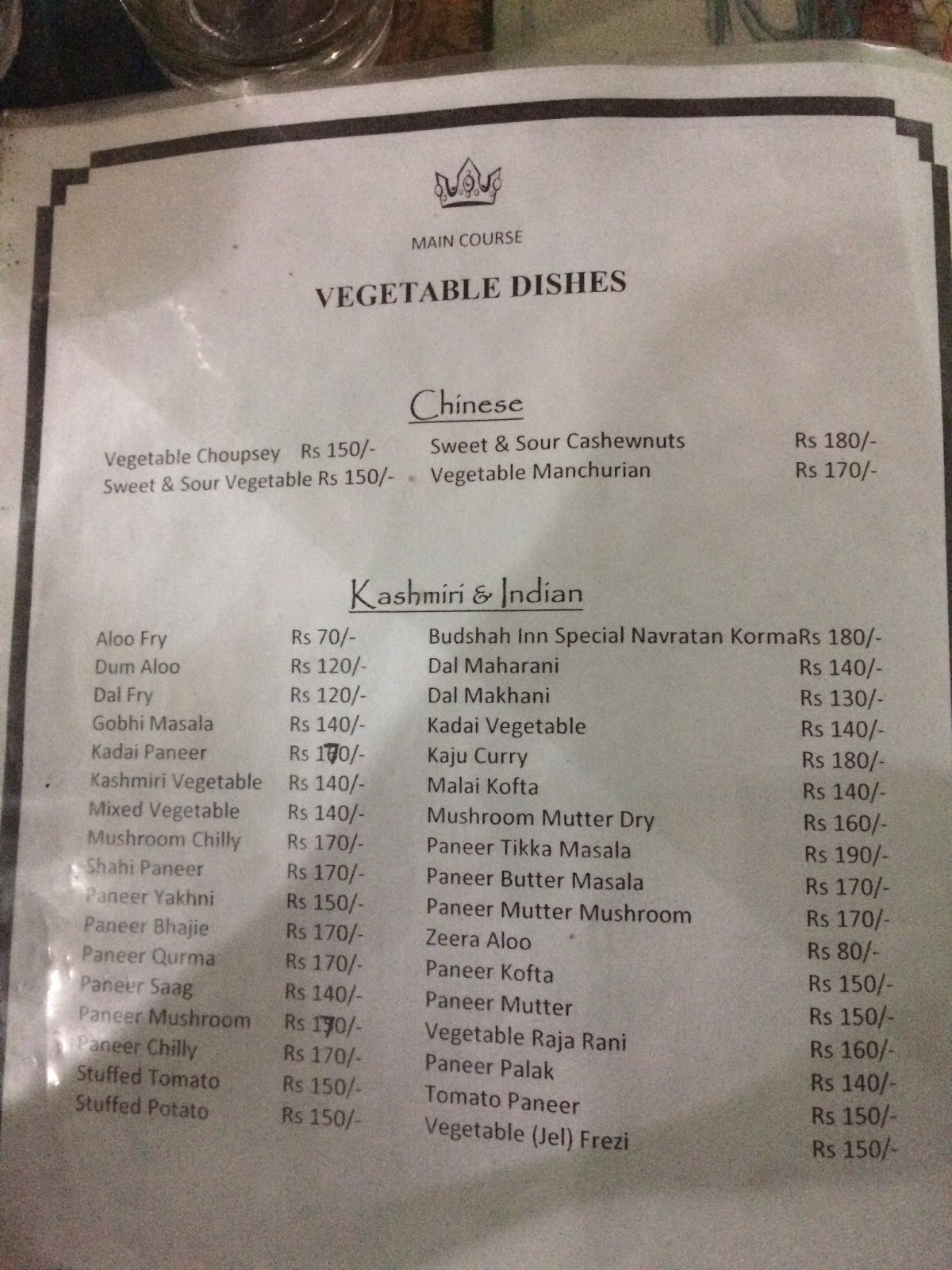
If you are in mood for authentic Kashmiri food, try Budshah Inn Restaurant near old Tibetan refugee market. 


Thursday, June 23, 2016

HOW I GOT LEH'ED: DAY1 Do Nothing


CONTENT
Summary
Day1: LEH - Do Nothing
Day2: LEH-Around
Day3-4: LAMAYURU
Day5,6,7: NUBRA - PANGONG TSO
Day8: LEH
Day9: TSO MORIRI

If you love to visit the hill stations… do not go to Ladakh…

…Because once the charm of the land of Chortens mesmerise you, it would be difficult for you to like any other place.


While the photos of Ladakh are tempting, many people are afraid to go there due to the high altitude.

MY TAKE: Unless there are any serious health issues, anybody can visit Ladakh. 

We went with our daughter who is less than 5 years old and my father who is well over 70 years. We had no issues. The key is acclimatisation.

DAY1:

Our trip to Ladakh was for 10 days (mid-June), and we flew from Delhi. The birds-eye view of the wrinkled Himalayas garnished with snow was a pleasure to the eyes. 

View from the flight


The landing was steep. Coming from Gurgaon, the deep blue sky felt so good. There was less oxygen in the air, but less pollution too. I will take that any day.


TIPS: Most flights are morning flights. Take the left seat while going to Leh so that the sun is not directly on your eyes. You will get better pictures too.

Once you are in the Kushok Bakula Rimpochhe Airport in Leh the signboards will warn you about AMS, a term you are going to hear a lot when you will be planning your trip. AMS simple means Acute Mountain Sickness. There are other altitude related sickness as well. I do not want to go into details of it, there are plenty of stuff in the internet. The more you read, the more you will be frightened.

MY TAKE: Don’t read too much!

Like I said before, the key is acclimatisation. All you need to do is follow some simple tips.

‘Don’t be Gama in the land of Lama’ - A signboard in Leh

TIPS: 
  1. Rest in the hotel for at least 24 hours, if not 36hrs. Make sure you carry something to keep yourself entertained (Don’t depend on internet), because it is going to be a boring start to your exciting trip. Sleeping is not an option. You are not supposed to sleep in the afternoons! 
  2. No smoking or drinking alcohol.
  3. Do not do a lot of physical activities on the first couple of days, which I was told includes sex. If you are travelling with kids, make sure they do not jump around a lot during the first day. Keep them engaged.
  4. Drink 2-3 litres of water a day. Not less, not more.
  5. Eat lots of carbohydrates. Forget KETO diet.
  6. If you are traveling with heart patients, old persons or small kids it is advisable to consult the family physician before hand.
  7. DIAMOX tablet helps fool the body to take more oxygen. Two tablets a day for 7-days starting one day before the date of travel. Again, consult a doctor.


We pre-booked our car for the entire trip, which was waiting outside the airport. the drivers are very punctual.
Unless you are driving your own car, you have to hire taxi from locals only. It is a monopoly of local taxi union, which makes it expensive too. However, it is a short 4-5 months season. That is the only time these guys earn money, that helps them survive the rest of the harsh winters. When you think about it, it is not that unfair.

MY TAKE: We were lucky to have a polite driver named Rigzin. He has more than 12 years experience, and knows every road in Ladakh by heart. He is also a very skilful driver. His number: +91 95-96-604991. 10 days cost us ~40,000 INR

Rigzin


The car took us directly to our hotel.
There are many hotels in Leh to match all budgets. 

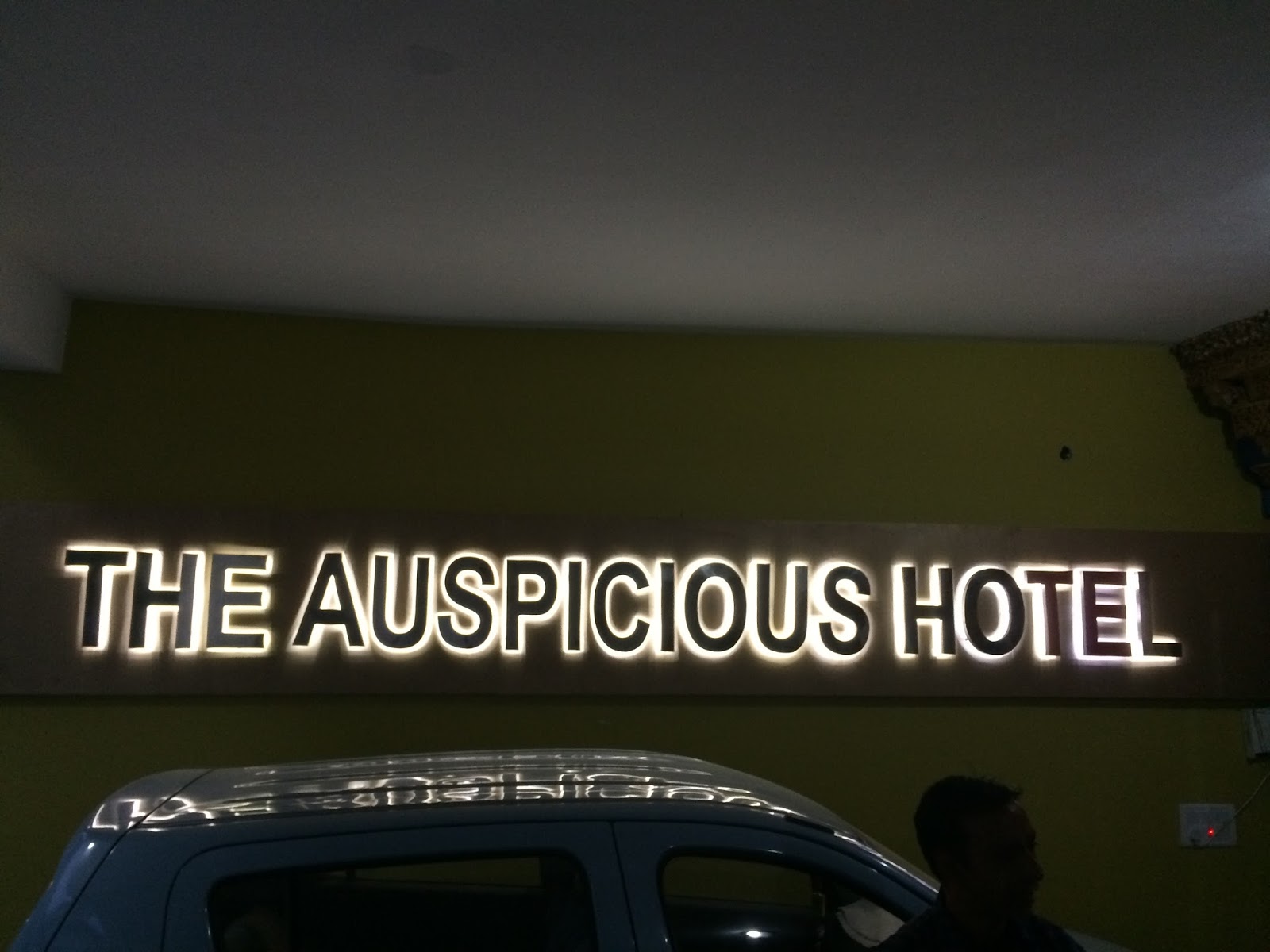
MY TAKE: Stay at The Auspicious Hotel. 
contact: Mr Robin +91 94-19-177864
review: Comfortable hotel with very friendly staff.
Rooms are nice clean and big.
While away from the noise and pollution of the main market, it is just 2-3 minute walk to the market.
Food is good. Non-veg is limited. They serve buffet. Breakfast is complimentary.
Free Wifi (slow connectivity).
Book in advance. They are mostly full in peak seasons.


With Robin
The Auspicious Hotel


Phone connection will be an issue. Only BSNL and Airtel post paid connections work, that also mostly in Leh. Plan accordingly. Forget mobile internet. I was looking desperately for the Airtel girl. It seems the Airtel network only follows her like the hutch puppy. Dogs are supposed to be loyal to only one person anyways. Neither could I find her, nor the 4G. Forget 4G, even 2G is very very slow. You are here to enjoy nature, forget internet for few days. 


Though the outside temperature was around 15C, out in the sun it felt like 40C. Once the sun was down it became cold again very fast. So, pack for both winter and summer.

TIPS: Good idea to take Shades, hats and or umbrellas, sunscreen, few summer clothes.


While having our meals we realised two things: Fish is the beef of Leh and egg is veg. Fish is supposed to be holy, I was told by the chef. So no F-word for dinner. Non-veg was limited in most paces. be prepared to have a lot of noodles, momo  and thuppa. Egg, however, was available in most places; even in the vegetarian restaurants.

Fish in one of the important symbols of Tantric Buddhism


We spent the first day resting, trying not to sleep, eating lots of carb, and drinking lots of water. 

Click for DAY 2


Wednesday, May 25, 2016

Candy Balls....Or are they?

In the middle of a hot desert, few hungry gold miners stumbled upon some naturally growing candies. When they licked it they tasted sweet. The miners started eating the sweet candy-like things until they felt nauseated. Soon, to their horror, they realised what they just ate.

This story of gold miners is from mid-19th century Nevada.

Those sweet candy-like things were actually packrat middens!


Now let me explain what that means.

Packrats are large rodents that constructs ball-shaped debris piles called middens. Middens are used to built their den. They consists of plant fragments, small rocks, dungs, bones, food remains and their own feces.

But why sweet candies?

This is the interesting part. The naughty rodents urinate on their own den. The sugars, along with other things, crystallize from the urine on the top of the middens, making it sweet. The hard sugar coating also helps in binding the middens and preserve the materials inside.

Midden is derived from the word 'mess'. They did mess with the poor gold miners. Packrat poop and urine for dinner! Yummy!


The middens are actually important pieces of mess. Under right (dry) conditions they can can be preserved for ~50,000 years. Geologists, palaeontologists to be precise, love them. They are like libraries that preserve the climate information, flora and fauna of the past. Important shit these.


REF#
1] Collapse by Jared Diamond, Penguin India, 2011
2] Wiki

Sunday, May 22, 2016

The Drunk Couple


Aihole (Karnataka) is a small little village that once was the cradle of South Indian temple architecture. Young architects came here to learn. They let their imaginations loose to create the beautiful sculptures that are seen in the 125 stone temples built by the Chalukyas.

The life of locals inspired them. It was a different era, different culture, different moral guidelines and different prejudices. 

In the sculptures you will find couples of 5th-century romancing, flirting, teasing, and even fighting with each other. This particular sculpture is called the drunk couple. From their appearance it seems like they are wealthy nobles. Our guide told us that the two attendants are bartenders. The lady is too drunk to stand, or even hold on to her clothes. 

He further explained with lots of excitement that she had vomited and the dog was eating it. Even as she struggled to stand, one can see the love she has for her caring lover. She wraps one arm around his shoulder and looks affectionately into his eyes. 


Let there be love…let there be peace. Cheers!


Written by Subhrashis Adhikari
Author of 5 Questions of the Inquisitive Apes
"Engaging and entertaining, this page-turner is remarkable in its narration and will give you a new perspective on various aspects of life. Wellresearched and heartfelt, the encouraging tone throughout the book tries to motivate towards a happier life." - Times of India
Link:


Thursday, May 19, 2016

Right and Left!

Obama says that it is not cool to not know what you are talking about. Now I know where he is coming from. Cool is a verb that means ‘make less hot’. The ‘not-so-racist (?)’ Ben Garrison’s cartoon on first lady clearly shows that Trump’s speeches has not made Melania Trump a fraction of degree less hotter. Which proves that his speeches are definitely not cool. Since Trump’s ‘un-cool’ [read ‘not knowing what he is talking about’] speeches have made him popular, I am going to make this post ‘un-cool’. Being ‘un-cool’ is a sure road to success. If you don’t believe me, listen to any speech given by the Royal Bengal Didi and think about today's results.


With Right coming to power in a not so right democracy of India, and Trump’s increasing popularity in the self-proclaimed idol of democracy, the debate between Right and Left has heated up. I see many of my friends in social media post long ‘un-cool’ messages on why the other side is not right. Since some are shouting ‘Right’ while others shouting ‘Left’, the debate is confused about the direction it should head. So I thought of writing a post on the ideologies of ‘Left’ and ’Right’, especially because I do not know what I am going to write about. Which is going to make this post ‘un-cool’ and thus popular. Well, I wrote an entire book without knowing what I was writing about, and this is just a mere post. Below is the out-of-place, shameless and self-promoting advertisement of my book.

The word ‘right’ itself is so cool because it sounds so ‘right’! So people who think they are right, and has the right to make everything right, by doing whatever righteous acts they can, belong to ‘Right’ ideology. The word ‘left’ on the other hand sounds so un-cool. It sounds like ‘left-overs’, ‘left-out’…etc. So people who think they are Left has left-out the old ideologies and are trying to make a new one with whatever is left of their world.


The terms ‘Right’ and ‘Left’ were born pretty much accidentally. It has nothing to do with ideologies, and everything to do with the order in which few French rested their bum, way back in 1789! During the French Revolution the members of National Assembly was divided into two groups. Those that supported the king and the established order sat on the right, and the revolutionaries who wanted to get rid of the king sat on the left. That’s how the two ideologies got its name.

The Left has created an interesting problem for the Right. Left is against established order and wants rapid change that will give power to ordinary people like farmers and labors. That is bad for both businessmen and religious bodies. Though religion is business for priests and business in religion for businessmen, the two does not go hand in hand. Ideologically business is materialism and religion is salvation. Business requires science, technology, and people taking risk instead of believing in destiny. However, the problem of Left has created an unlikely ally as both of them support the Right. Established order also includes culture, history, political border, flags, national anthems, and thus nationalism. The aggressive nationalists thus tend to be Right. So when they want to chop off heads of persons who won’t say ‘Bharat mata ki jai’, they are ‘Right’. When they kill because someone was suspected of eating beef, they are ‘Right’.

The Left, on the other hand, is against the monopoly of industries or temples/churches.  They want everybody to be equal, even if it means everyone is equally poor. They are atheists who claim to fight for human equality, liberty, socialism, and of-course ‘aazadi’. To Left, all the problems in the society are because of the people with money and power, as long as those people are not leaders of left. Social equality takes precedence over economic growth. The ‘haves’ are taxed to give subsidy to the ‘have nots’. So when they want to kill judges who punished terrorists, in the name of equality, they are Left. When they want freedom from who-ever is ruling, they are Left. When they want oppression by anyone, other than fascists’, to end they are Left.

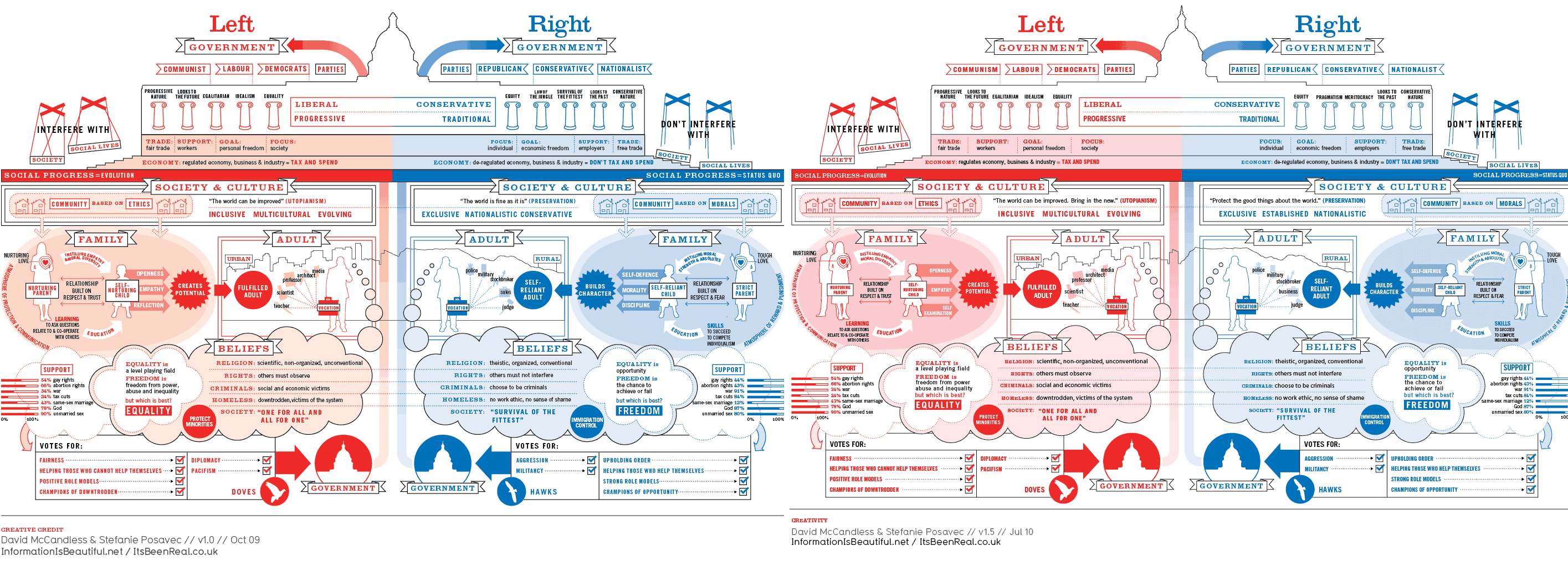
Now most people are not extreme, they fall somewhere in-between. One can classify them like below:

or 


Ideal Right wants to hold on to the past- past is good, change is bad. They will fight and kill to protect the golden past, the traditions and culture. Ideal Left wants to break free of the past- past is bad and oppressive, and change is good. They will fight and kill to destroy the rotten past. So, when someone call themselves Left or Right, they basically are people who follow rules and don't use their brains. Once someone starts thinking he or she would realize that ideologies change with situations and through time. Thinkers are a risk to political ideologies and thus politicians. Coming to think of it, the terms Right and Left are misnomers. They should be called ‘Heads’ and ‘Tails’ instead, because they are two sides of the same coin. But then again...I don't know what I am talking about.

Monday, March 7, 2016

History of Indian Geology

Geologists, a study found, are the happiest students in campus. Being the only species that can survive just on fermented products, it is not a surprise. There are two thing geologists are fascinated about - rocks and on-the-rocks. Indian geologists, however, have not received the fame their western counterparts enjoy. You don't see Bollywood movies where geologists save people from deadly volcanoes or earthquakes. Indians have been exploiting the vast mineral resources of India for thousands of years. Books have been written describing the locations and identification criteria of precious stones and metals. But, geology as a subject, was brought to India by the Englishmen who wanted to find all hidden resources in the new land that they now governed. East India Company started mineral exploration in India from 1774.

The early geological observations was made in India not by a geologist, but by a zoologist named Francis Buchanan. He surveyed Mysore in 1800 and Bengal between 1807 and 1814. It was Francis who started the Alipore zoo in Kolkata. He noted down in details all the rocks he saw, even those which were used to make temples. He penned his observations in his book ‘Journey from Madras through the countries of Mysore, Canara, Malabar’. Again, it was a statistician named W.H. Sykes who recognised and coined the term ‘Deccan Trap’ in 1833. ‘Deccan’ comes from ‘Dakshin’ meaning south, and ‘trap’ from the Swedish word ‘trappa’ meaning stairs or terraces. These continental flood basalts formed at the end of Cretaceous Period triggered by the India-Seychelles break-up. Some blame the dangerous Deccan volcanism for the extinction of the dinosaurs. Bones of dinosaur was recovered from beneath the traps in Jabalpur by Sleeman. The bones of the Titanosaurus indicas was sent to Kolkata. The bones were confirmed to be that of dinosaur only in 1877. Decades later the dinosaur was gone. The Titanosaurus was rediscovered in 2013. It shy dinosaur was hiding inside a cupboard in Kolkata's Geological Survey of India.

The Doom of Dianosaurs

While the first geological map in the world was made way back in 1743, India had Her first geological map only in 1821. The map was that of Hyderabad, made by Dr. H W Voysey, often called as the father of Indian geology. In fact, geology as a science was taken up for the first time by Asiatic Society of Calcutta in 1808. The 27 year old geologist, H W Voysey, was sent to Calcutta as Surgeon of Trigonometric Survey. Trigonometric survey of entire India was started by William Lambton in 1806. George Everest assisted Lambton, and later succeed him. Appointment of a geologist in Trigonometric survey puzzled Voysey’s colleagues. Hastings had to clarify the need of a geologist in India. A geologist was necessary to understand the density of the  different rocks in the subsurface that deflected the plumb line while taking trigonometric measurements. Apart from gravity, there were magnetic anomalies that affected the surveys as well. One eccentric Dr. Robert Tytler died while trying to hunt down the magnetic pole near one such anomalous ferruginous hill in Gwalior. Voysey came to India to simply help in understanding the anomalies, in which he was not very successful. His mapping did help in understanding the geology of India. However, understanding geology was not why the government paid him. Despite objections from George Everest, Voysey’s salary was cut due to long absence from regimental duties, and he resigned from the post. Soon after, he died of malaria at a young age of 33 years while travelling to Kolkata (Calcutta).

The year before Voysey’s death, in 1823, local Indians presented Captain S Webb with ‘bijli ki har’ - the bones of lightening. These Himalayan fossils were used by local as charms, or by native doctors as medicines. Webb knew that the British would be able to make a better scientific interpretation of these fossils. He send them to The Royal College of Surgeons of England. The fossils were interpreted as an evidence of the great flood. More surveys were undertaken to find the animals that perished in the flood. Attempt was also made to relate the fossil finds to ancient Indian texts. When a giant fossil of turtle was discovered, some wondered if it was the Kumra (tortoise) Avatar of Vishnu. More vertebrate fossils were discovered from what is now known as the Siwalik Group. The name is taken from the Siwalik Hills. Siwalik literally translates to the ‘tresses of Lord Shiva’. Siwalik group are molasses deposits formed by erosion of sediments from the rising Himalayas. They are around 5000m thick and cover the entire Indo-gangetic plain. The dead animals of Siwalik provided the fundamentals in understanding the Mio-Pliestocene epoch. They unfortunately said nothing about the great flood, nor was the fossil of Matsa (Fish) Avatar ever recovered!

The real need of geologists in India came from the coal industry that fuelled the Industrial Revolution in Britain. Raniganj Coalfield was the first field to be commercially mined in India. It was discovered in 1774 by John Sumner and Suetonius Heatly of the British East India Company. A new coalfield was discovered in Angul, Odisha in 1837. It was the Talchir coalfield, and it would bring a new puzzle for the geologists, to which we will come back later. Mining was mostly haphazard until the Coal Committee of India was formed in 1836. Geologist D. H. Williams was called from Britain to do a survey of Ranijanj, Jharia and Karanpura coal fields. He was appointed the Geological surveyor in 1846. Unfortunately, he fell from his elephant and died of ‘jungle fever’ in 1848. Three years later Geological Survey of India (GSI) was officially formed.

Establishment of GSI attracted more European geologist to India. The Irish Medlicott brothers made immense contribution towards Indian geology. They worked mostly around central India. While elder brother Joseph found the important Narmada-Son lineament, younger brother Henry worked the Vindhyas in detail. Proterozoic Vindhyan formation contains one of the oldest known life form on earth. Henry laid the foundation of Himalayan geology and is also credited for coining the term ‘Gondwana’ in 1872. ‘Gondwana’ means the ‘land of Gonds’. ‘Gond’ was probably first used by the Afghan traders for the Khond (hill) tribes in the 11th century. The rock Khondalite (Garnet-Sillimanite-Schist) also takes its name from the same tribe. It was the coals of Permian formations of Gondwana that attracted the geologists. Glossopteris was the key fossils of the Gondwana coals. Joseph identified the Lameta Formation and sub-divided the coals into Talcher, Damuda and Mahadevas in 1860. Joseph also noted the difference of these rocks from those of Vindhyans. The latter was only found north of the Narmada-Son lineament. However, it was not the Medlicott brothers, but Blanford brothers who found the big puzzle.
While studying the coal beds in mid 1950’s the Blanford brothers found huge boulders that could not have been carried by anything other than glaciers. On noticing closely, these boulders had stripes that confirmed them as glacial deposits, something unexpected in these part of the world. Similar boulders were soon found all across India. Mr Oldham correlated them with similar beds seen in Australia. One way of explaining the puzzle was ice-age, a time when glaciers covered most of the earth. As earth warmed up, the ice melted leaving behind the glacial deposits. Forests took over that formed the Permian coal beds.

Before the glacial puzzle was solved another came up further north, on the foothills of Himalayas. It was the old puzzle of gravity anomaly that Voysey was not able to solve. Some errors in positioning were noted by the surveyors while doing trigonometric survey south of the Himalayas. The position from Trigonometric survey done by astronomical measurement did not match the one done by triangulation. The extra gravitational pull from the Himalayas were thought to be the reason for the anomaly by Mr. Everest. To get a better hold of the measurement a mathematician, the Archdeacon of Calcutta, was recruited.

John Pratt was a brilliant mathematician. He became the chaplain of the East India Company in 1838. In 1850 Pratt became the Archdeacon of Calcutta. While studying the anomalies he found that the results were counter-intutive. The mountains attracted the plumb line less than it should, as if they were hollow. While similar measurements near the beach had opposite affect, as if there was an invisible mountain in the ocean. Pratt wrote a paper with his observations, which went to another mathematician, George Biddell Airy, for review. Airy was already a respected scientist. Airy, the man who calculated the mean density of earth, had better explanation for the anomaly. Mountains, he explained, were blocks of lighter crust that floated on the heavier asthenosphere. Mountains have roots of lower density material and thus pulled less. The oceans have anti-roots that pulled the plumb line towards itself. Airy published his hypothesis of isotacy along with Pratt in 1855. Two years later the revolt of 1857 took place and the Queen of England replaced the East India Company. GSI, however, continued to function. Indians started to join GSI, Ram Singh being the first one to join in 1873.

If the lighter continental crust is floating, does it swim as well? That questioned would not be answered soon. The geologists would take one step closer to the answer, but not before really messing it up. Glossopteris was the main plant fossil in the Gondwana coals. The term ‘Glossopteris’ was coined by a French geologist named Adolphe Theodore decades back in 1828. It means ‘tongue fern’ in Greek. Though it looks like a fern, it was later classified as gymnosperm. They are tall trees, sometimes growing 30m high, and produce seeds. Glossopteris became extinct at the end Triassic. The fossils of Glossopteris was studied in detail by Austrian geologist Eduard Suess. He found similar fossils from not just India but also South Africa, Madagascar, Australia, South America and later from Antarctica. Glossopteris fossils of Antarctica was discovered by the famous Robert Falcon Scott. Scott could never make it out of the continent with his Glossopteris. He was buried with his fossil collection, which was recovered later.


Suess claimed in 1885 that land bridges connected the continents containing Glossopteris fossils. He named this super-continent Gondwanaland, “after the ancient Gondwana flora which is common to all it’s part.” Further studies unearthed other similar flora and fauna from these distant continents that were not connected. The mystery of this strange connection between far-away lands bred new myths, and sometimes fuelled old ones. People started to hypothesis lost continents that sank beneath the ocean.
Lemuria - The Lost Continent


Finding of the fossils of Lemurs in India and Madagascar, but not Africa, was an anomaly that confused zoologist and biogeographer Philip Sclater. He proposed in 1864 that there was a lost continent, that he named Lemuria, which acted as land bridge between India and Madagascar. Lemuria caught the fancy of occultist Helena Petrovna Blavatsky. To her it was the land where superior, and spiritually more pure, humans lived. Blavatsky moved to India in 1880 where her cult movement got help from Dayananda Saraswati's Arya Samaj, a Hindu reform movement. She wrote about it in her book ‘The Secret Doctrine’. After she died of influenza she was succeeded by her disciple Annie Besant. The Tamil politicians later misused the discredited idea of Lemuria. Lemuria became the lost Tamil continent Kumari Kandam - the cradle of civilisation. According to them the last bit of the continent still exists in Kanyakumari. At that place now stands the Vivekananda Rock Memorial - where Swami Vivekananda received enlightenment before leaving for the World Congress of Religions of 1893 in Chicago. That piece of rock, where the memorial now stands, is composed of Charnockite.

The Charnockites formed deep within the crust 550 Million years ago when India fused with Antarctica. Kanyakumari was the triple junction along which the Gondwana break-up took place in Jurassic.  We now know that there were no lost continents, but India, Africa, Antarctica, Australia and Latin America were once fused together into one super-continent that we now call Gondwana (without the ‘land’ as ‘wana’ already means land). 

Gondwana


The Charnokies were named by Thomas Henry Holland in 1893 after Job Charnock, the founder of Calcutta. It was the same rock with which the tombstone of Job Charnock was made. Holland later became the director of GSI in 1904. He realised that the geological history of India did not match that of Europe. He proposed four new geological eras for India based on the unconformities found in India. They were Archaean, Purana (Proterozoic), Dravidian ( Cambrian to Middle Carboniferous) and Aryan (Upper Carboniferous to recent).


GSI continued to function actively after Independence. It was headed mostly by European geologists. However, Indians were being trained in the subject in colleges like Presidency College Kolkata where geology was taught since 1892. Maharajapuram Seetharaman Krishnan was the first Indian director of GSI. His book on Indian stratigraphy is still read geology students of India.